
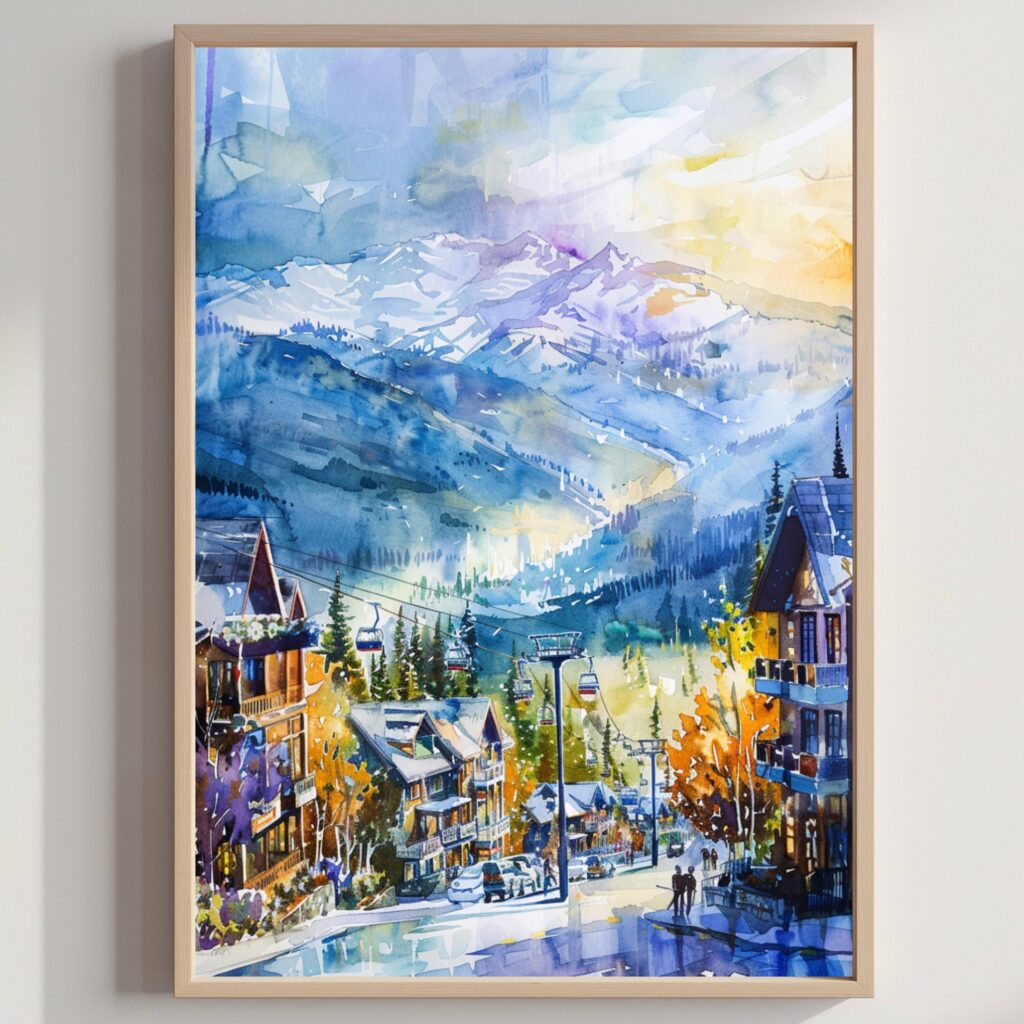
Whistler’s development as a major ski destination began with a genuinely ambitious, initially unsuccessful goal, a group of Vancouver businessmen developed the resort in the 1960s specifically hoping to host the Winter Olympics, a bid that was rejected multiple times over subsequent decades before finally succeeding when Vancouver-Whistler was awarded the 2010 Winter Games, over 40 years after the original vision first took shape. That prolonged pursuit meant Whistler had already developed into a world-class ski resort long before the Olympics arrived, the eventual Games simply confirming a reputation the resort had spent decades building.
Whistler Blackcomb, formed by the merger of two adjacent mountains, offers one of the largest lift-served vertical drops in North America, and the Peak 2 Peak Gondola, connecting the two peaks, held the record for the longest unsupported span of any cable car in the world upon its completion in 2008, engineered to cross a valley without a single supporting tower along nearly 3 kilometres of cable.
A Resort Built With Indigenous Partnership
The 2010 Winter Olympics in Whistler were notable for the unusually direct involvement of local First Nations, the Squamish and Lil’wat peoples, whose traditional territory includes the resort, participated formally as official Games partners rather than simply as a backdrop, a relationship reflected today in the Squamish Lil’wat Cultural Centre, built specifically to share and preserve both nations’ history and culture directly within the resort village. That partnership reflected a broader, still-evolving effort within Canadian institutions to more directly acknowledge and include Indigenous communities in major national projects and events.
Whistler Village itself was purpose-built as a pedestrian-only town centre, a deliberate design choice from the resort’s early planning that has since been widely studied and replicated by other ski resort developments seeking a similarly walkable, car-free base area.
Painting Snow-Capped Peaks Above a Mountain Village
Whistler’s dramatic snow-covered peaks above its pedestrian village give a watercolourist bold alpine scale and crisp winter light to work with. We’ve captured that setting in our own Whistler Watercolor Print, painted first by hand and printed to order on archival paper, a small piece of British Columbia for a wall at home.
Pursued for over 40 years before finally landing its Olympic moment, Whistler remains proof that persistence, in resort development as much as anything else, eventually tends to pay off.