
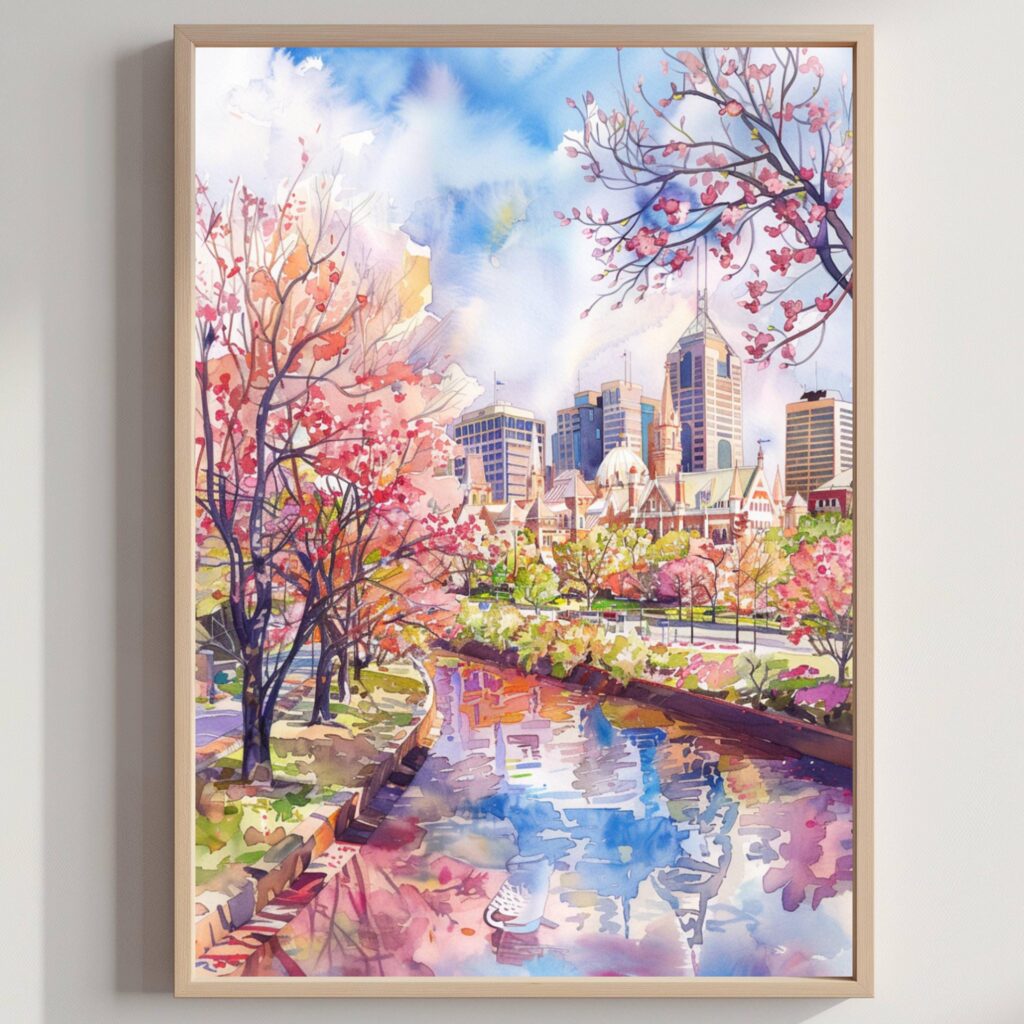
Adelaide is among the few major cities in the world whose layout was completely designed before settlement began, surveyor Colonel William Light drew up the city’s distinctive grid plan in 1837, encircled entirely by parklands, before colonists had even selected the final site, a level of deliberate advance planning highly unusual for the era. Light’s design faced significant opposition from colonial officials who wanted the city sited closer to the coast, but he held firm, and Adelaide’s ring of green parkland surrounding the city centre remains largely intact today, protected by law from further development.
That original layout gave Adelaide one of the most consistently praised urban designs in Australia, wide boulevards and public squares built into the very fabric of the city rather than retrofitted later, a structure that has aged remarkably well across nearly two centuries of growth.
A City Built Without Convict Labour
Unlike Sydney and several other early Australian colonial settlements, Adelaide was founded as a free colony in 1836, established under the South Australia Act specifically without the use of convict labour, a founding principle that shaped the city’s early social and civic identity distinctly from its penal-colony counterparts. That free settlement history contributed to South Australia’s early reputation for religious tolerance and progressive social policy, the state became the first in Australia to grant women the right to vote and stand for parliament, in 1894.
Adelaide’s Barossa Valley and McLaren Vale wine regions, both within a short drive of the city, have developed into some of Australia’s most significant wine-producing areas, German immigrant winemakers in particular shaping the Barossa’s distinctive Shiraz tradition since the mid-19th century.
Painting Parklands Around a Planned City
Adelaide’s green parkland ring against its orderly city grid gives a watercolourist a distinctive, deliberately composed urban landscape to work with. We’ve captured that planned character in our own Adelaide Watercolor Print, painted first by hand and printed to order on archival paper, a small piece of South Australia for a wall at home.
Designed entirely on paper before a single building rose, Adelaide remains one of the clearest examples anywhere of a city that simply followed its original plan and let it work.