
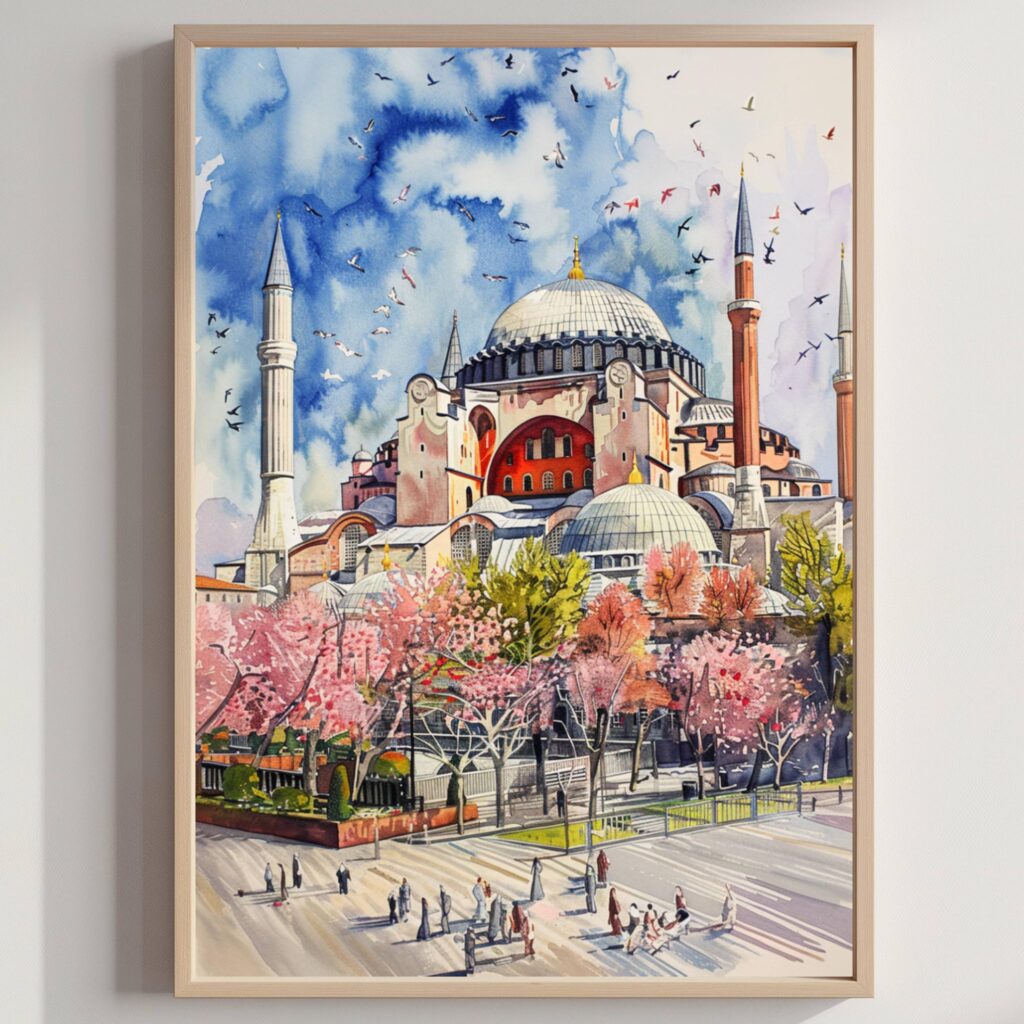
Hagia Sophia was completed in 537 CE under the Byzantine Emperor Justinian I, and for nearly a thousand years afterward, it held the distinction of being the largest cathedral in the world, its massive central dome, considered a genuine engineering marvel for its era, appears to float almost weightlessly above the interior, an effect achieved through a ring of windows at its base that Byzantine architects deliberately used to obscure the supporting structure from view.
Following the Ottoman conquest of Constantinople in 1453, Sultan Mehmed II converted Hagia Sophia into a mosque, adding minarets and covering, rather than destroying, many of its Christian mosaics with plaster, an act of practical religious conversion that inadvertently helped preserve much of the original Byzantine artwork beneath, work later uncovered during 19th and 20th-century restoration efforts.
A Building Repeatedly Redefined by Political Change
In 1934, under Mustafa Kemal Ataturk’s secularising reforms following the founding of the modern Turkish Republic, Hagia Sophia was converted into a museum, a status maintained for 86 years and intended specifically to present the building as a shared monument of world heritage rather than belonging exclusively to either the Christian or Islamic tradition. That museum status ended in 2020, when a Turkish court ruling and subsequent presidential decree reconverted the building back into an active mosque, a decision that drew significant international attention and mixed reactions both within Turkey and abroad.
Despite these repeated changes in religious function, Hagia Sophia’s Byzantine mosaics remain visible today, partially covered during prayer times with curtains or panels rather than permanently obscured, a physical compromise reflecting the building’s continued, contested status as a site sacred to multiple faiths and claimed by multiple, sometimes competing, historical narratives.
Painting Domes That Have Outlasted Every Regime
Hagia Sophia’s massive dome and minarets against Istanbul’s skyline give a watercolourist extraordinary architectural scale and layered history to work with. We’ve captured that presence in our own Hagia Sophia Watercolor Print, painted first by hand and printed to order on archival paper, a small piece of Istanbul for a wall at home.
Church, then mosque, then museum, and now a mosque again, Hagia Sophia remains a building whose very function has repeatedly reflected whichever empire or nation happened to hold Istanbul at the time.