
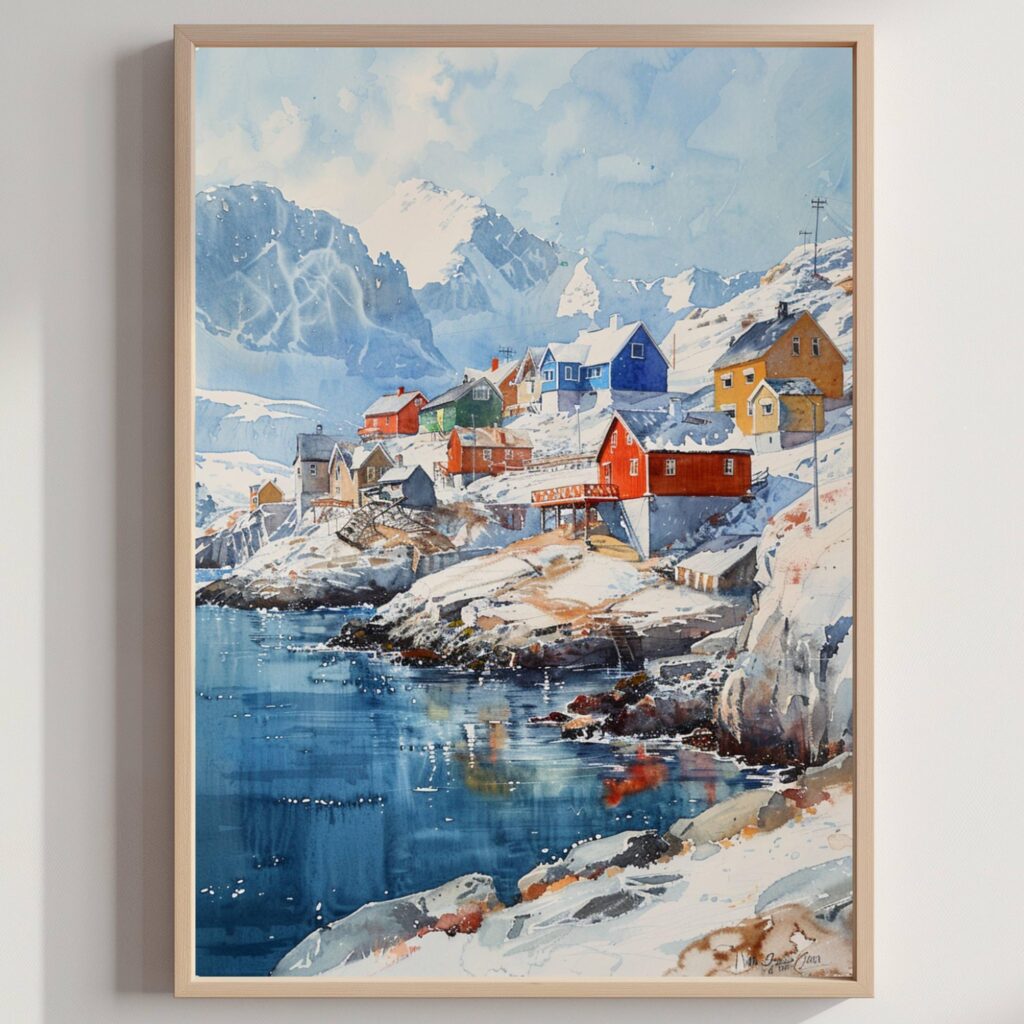
Nuuk, Greenland’s capital, has a population of under 20,000, making it, by most measures, the smallest capital city in the world relative to the territory it governs, Greenland itself spans over 2.1 million square kilometres, the largest island on Earth, yet remains home to fewer than 60,000 people total, most of that vast landmass covered by a permanent ice sheet second in size only to Antarctica’s. That extreme disparity between land area and population shapes nearly every aspect of Greenlandic life, communities scattered along the ice-free coastal fringe, connected more often by boat or aircraft than by road.
Nuuk was founded in 1728 by Danish-Norwegian missionary Hans Egede, who arrived seeking descendants of earlier Norse settlers believed to still be living in Greenland, a Norse population that had, in fact, mysteriously disappeared centuries earlier, their fate still debated by historians and archaeologists today.
A Territory Still Negotiating Its Own Independence
Greenland remains an autonomous territory within the Kingdom of Denmark, having gained increasing self-governance since a 1979 home rule agreement and further expanded autonomy in 2009, though full independence remains an active, ongoing political conversation among Greenlanders, complicated by the territory’s continued economic reliance on Danish subsidies. Nuuk’s population is overwhelmingly Inuit, and the city increasingly reflects a deliberate blending of traditional Greenlandic Inuit culture with Danish colonial-era institutions and, more recently, growing international attention tied to Arctic geopolitics and climate change research.
Greenland’s ice sheet, and the rate at which it is melting, has become one of the most closely monitored indicators of global climate change, scientific stations across the territory tracking changes with direct implications for global sea level projections, making this remote, sparsely populated capital an unlikely but genuinely significant centre of international scientific attention.
Painting Ice, Rock, and Arctic Light
Nuuk’s colourful buildings against Greenland’s stark mountains and fjords give a watercolourist a genuinely singular Arctic palette to work with. We’ve captured that remote beauty in our own Nuuk Greenland Watercolor Print, painted first by hand and printed to order on archival paper, a small piece of the Arctic for a wall at home.
Governing the world’s largest island with one of its smallest capital populations, Nuuk remains a genuine reminder that scale, in Greenland’s case, rarely means what it means anywhere else.