
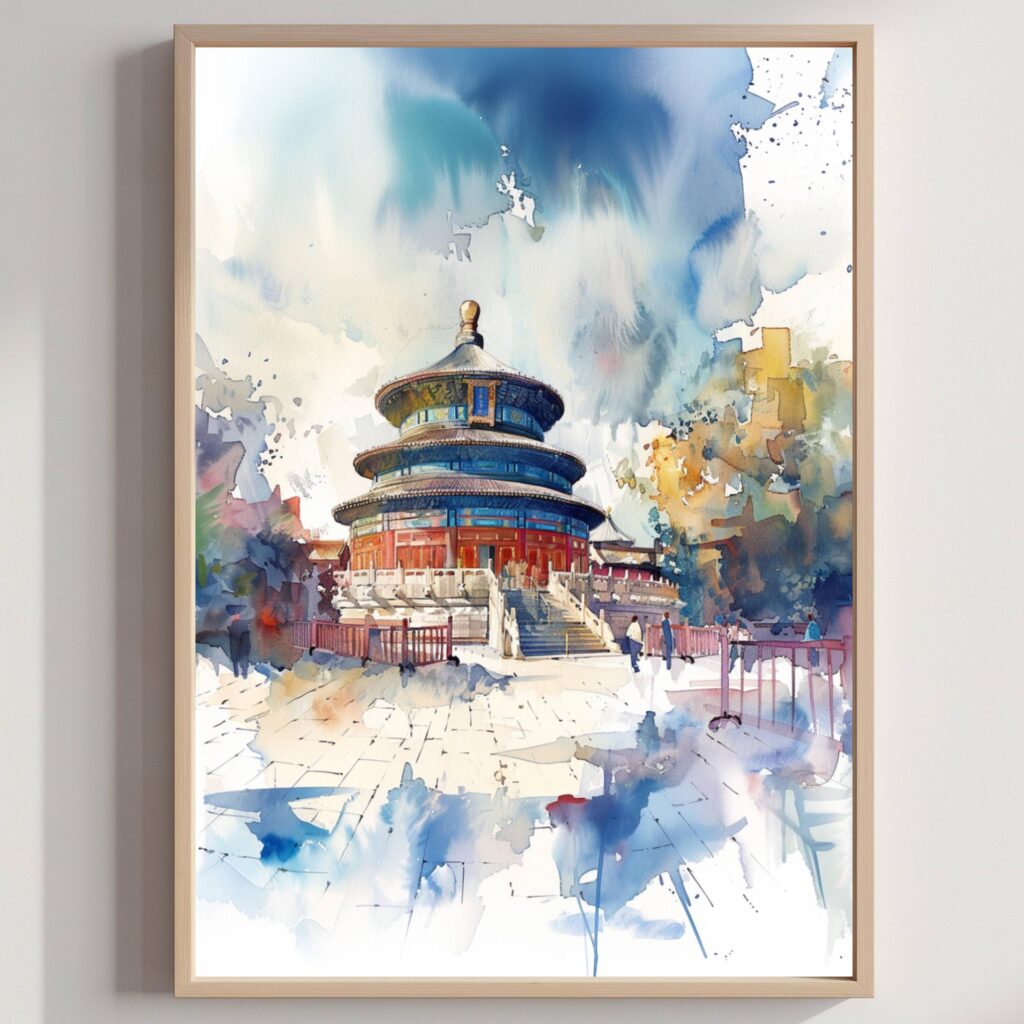
The Temple of Heaven was built in the early 15th century during the Ming Dynasty, and for nearly 500 years, its central rituals could be performed by only one person in the entire empire, the Emperor, who travelled there annually to pray for good harvests and perform ceremonies believed to maintain the delicate balance between heaven and earth. That exclusivity reflected the emperor’s role as the “Son of Heaven,” a title carrying genuine religious and political weight, his ability to communicate directly with heaven considered essential to the empire’s continued prosperity and stability.
The complex’s most iconic structure, the Hall of Prayer for Good Harvests, is built entirely without nails, its triple-tiered circular roof constructed using an elaborate system of interlocking wooden brackets, a construction technique demonstrating remarkable structural sophistication for its era, and one that has allowed the building to survive centuries largely without significant structural failure.
A Design Built Entirely Around Symbolic Numbers
Nearly every measurement and structural element within the Temple of Heaven complex was designed around specific numerological symbolism, the number nine, considered the most powerful number in Chinese numerology and closely associated with the emperor, appears repeatedly throughout the site, from stone slab counts to the layout of its circular terraces. The complex’s overall shape, round temples set within a square outer wall, deliberately reflects ancient Chinese cosmology, the belief that heaven is round and earth is square, a philosophical concept made physically, architecturally explicit across the entire site.
UNESCO designated the Temple of Heaven a World Heritage Site in 1998, recognising it as a masterpiece of architecture and landscape design that vividly illustrates a cosmology of central importance to Chinese civilisation for over two millennia.
Painting Circles Within a Square
The Temple of Heaven’s deep blue-tiled circular roofs against Beijing’s open sky give a watercolourist bold colour and precise geometric form to work with. We’ve captured that symbolism in our own Temple of Heaven Watercolor Print, painted first by hand and printed to order on archival paper, a small piece of Beijing for a wall at home.
Built for a single man’s annual prayer and now open to millions, the Temple of Heaven remains one of the clearest physical expressions of an entire cosmology ever constructed.