
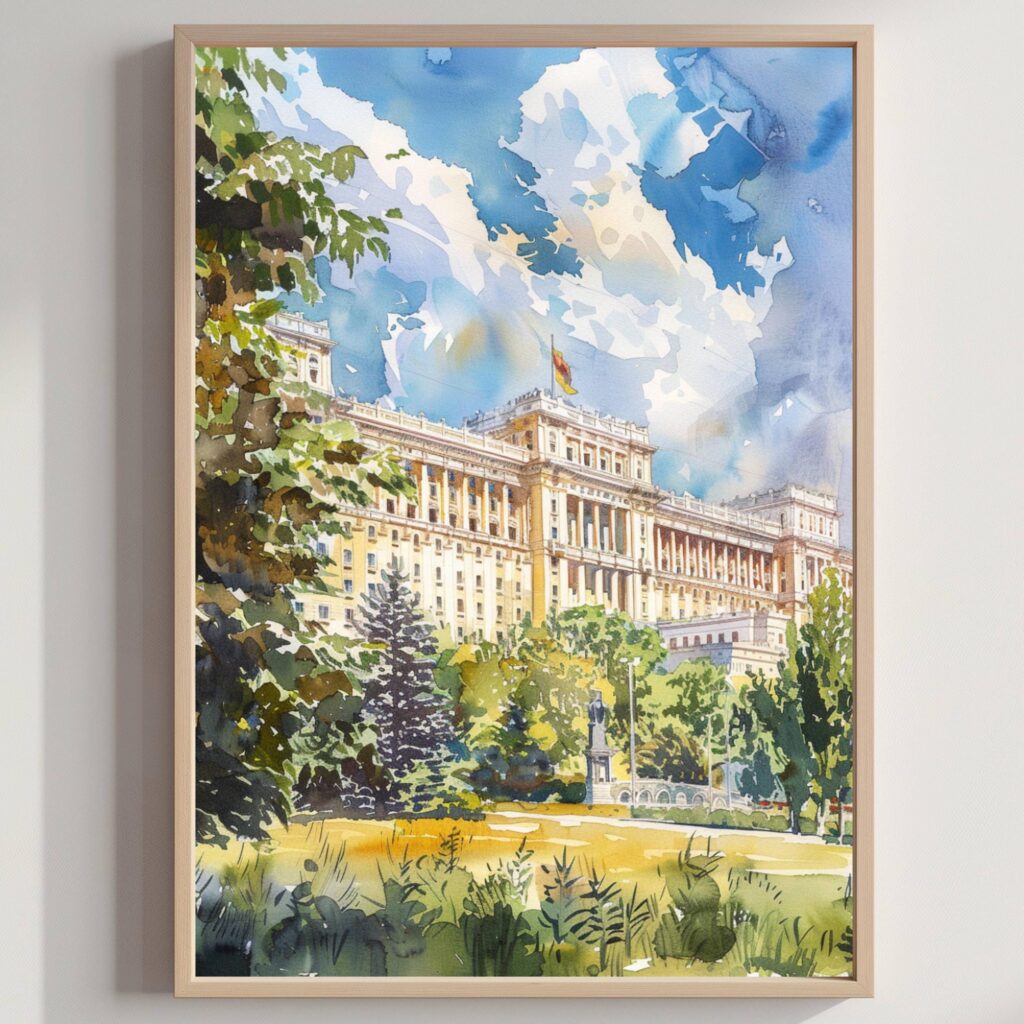
Bucharest earned the nickname “Little Paris” in the late 19th and early 20th centuries, when Romanian architects and elites, many educated in France, deliberately remade the city with Belle Epoque boulevards, ornate facades, and grand public buildings modelled directly on Parisian originals, an ambition reflected literally in the Casa Presei Libere, once compared to a smaller version of the Arc de Triomphe, and the Romanian Athenaeum, its concert hall considered one of the finest examples of Neoclassical architecture in Eastern Europe.
That elegant reputation was severely disrupted during Communist rule under Nicolae Ceausescu, whose regime demolished significant portions of historic Bucharest in the 1980s to construct the Palace of the Parliament, the second-largest administrative building in the world by floor area, a project so vast it reportedly required around a fifth of the entire city’s historic centre to be cleared to make way for it.
A Palace Built at Enormous Human and Historical Cost
Construction of the Palace of the Parliament displaced tens of thousands of Bucharest residents and consumed a staggering proportion of Romania’s national resources during a period of severe economic hardship for ordinary citizens, a stark, physical symbol of Ceausescu’s authoritarian excess that stands, uncomfortably, as one of the city’s most visited landmarks today. Ceausescu was overthrown and executed during Romania’s 1989 revolution before the building was even fully completed, leaving Bucharest with an enormous, still not entirely finished monument to a regime the country had just violently rejected.
Despite that disrupted history, pockets of Bucharest’s earlier “Little Paris” character survive, particularly around Calea Victoriei and the Old Town’s Lipscani district, now revitalised with cafes and nightlife occupying restored Belle Epoque buildings.
Painting Belle Epoque Facades and Grand Ambition
Bucharest’s ornate 19th-century facades against its dramatically scaled modern monuments give a watercolourist a genuinely striking historical contrast to work with. We’ve captured that layered character in our own Bucharest Watercolor Print, painted first by hand and printed to order on archival paper, a small piece of Romania for a wall at home.
Built once to resemble Paris and later reshaped by one of Europe’s most extreme building projects, Bucharest remains a capital whose architecture tells two very different stories about ambition.