
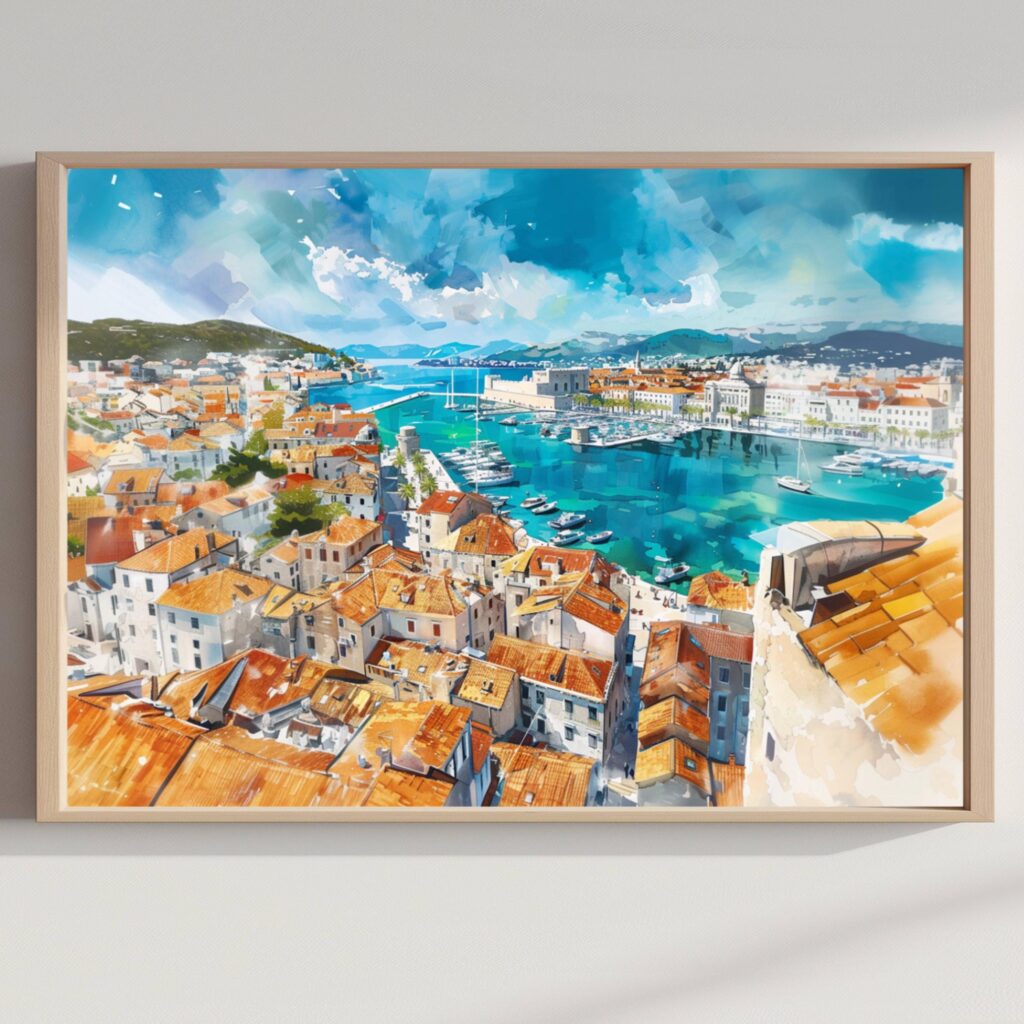
Split’s old town is built almost entirely within and around the walls of Diocletian’s Palace, a retirement residence the Roman Emperor Diocletian constructed for himself around 305 CE upon voluntarily stepping down from power, an unusual choice in an era when most emperors ruled until death or deposition. Rather than remaining a private residence, the palace complex was gradually settled and adapted by local residents fleeing barbarian invasions in the centuries after Rome’s fall, its massive walls and structure repurposed as the foundation of an entire functioning town rather than being abandoned as ruins.
That layered reuse continues today, ordinary apartments, shops, and restaurants now occupy spaces built originally as imperial chambers and temple structures, making Split’s old town one of the only places in the world where a Roman emperor’s palace has remained continuously inhabited for over 1,700 years rather than becoming a purely archaeological site.
A Cathedral Built Inside a Roman Mausoleum
Diocletian’s own mausoleum, originally built to house his remains, was converted into Split Cathedral in the 7th century, an irony not lost on historians, Diocletian was among the Roman Empire’s most notorious persecutors of Christians, and his tomb now serves as one of the oldest cathedrals in the world still using its original structure. The palace’s Peristyle, a grand ceremonial courtyard, remains the heart of the old town today, still used for public gatherings and events much as it was during Diocletian’s own lifetime, an unbroken civic function spanning nearly two millennia.
UNESCO designated the historic centre of Split a World Heritage Site in 1979, recognising Diocletian’s Palace as one of the most complete surviving examples of Roman residential architecture anywhere in the world.
Painting Roman Stone Still Lived In
Split’s ancient Roman walls, now woven directly into daily city life, give a watercolourist a genuinely layered sense of history to work with. We’ve captured that living history in our own Split Watercolor Print, painted first by hand and printed to order on archival paper, a small piece of Croatia for a wall at home.
Built as one emperor’s private retirement home, Split’s palace has spent the seventeen centuries since becoming something no emperor could have planned: an entire city that simply grew up inside it.