
The Bahamas is made up of roughly 700 islands and over 2,000 small cays, yet fewer than 40 of those islands are permanently inhabited, the vast majority remain undeveloped, some visited only occasionally by boaters or left entirely to seabirds and marine life. That scattered geography made the islands, historically, both a haven for pirates in the 17th and 18th centuries and, later, a strategic hiding ground for rum-runners during American Prohibition, the islands’ shallow, reef-strewn waters offering countless places for small, fast boats to disappear.
San Salvador Island is widely believed to be the site of Christopher Columbus’s first landfall in the Americas in 1492, though the exact island has been debated by historians for centuries, several candidates across the archipelago have been proposed based on differing interpretations of his ship’s logs.
Water Clear Enough to See the Seafloor From the Air
The Bahamas sits atop the Great Bahama Bank, a massive shallow limestone platform that gives the surrounding water its famously vivid, almost impossibly clear turquoise colour, shallow enough in places that the seafloor remains visible from commercial aircraft flying overhead. That shallow limestone geology also created the Bahamas’ famous blue holes, deep vertical caves and sinkholes, Dean’s Blue Hole among the deepest known in the world, that have become significant sites for both scientific research and competitive free-diving.
Nassau, the capital, developed around one of the best natural harbours in the region, and its historic Queen’s Staircase, 66 steps carved directly from limestone by enslaved labourers in the 18th century, remains one of the most visited, and most sobering, historic sites in the capital.
Painting Water That Barely Needs Blending
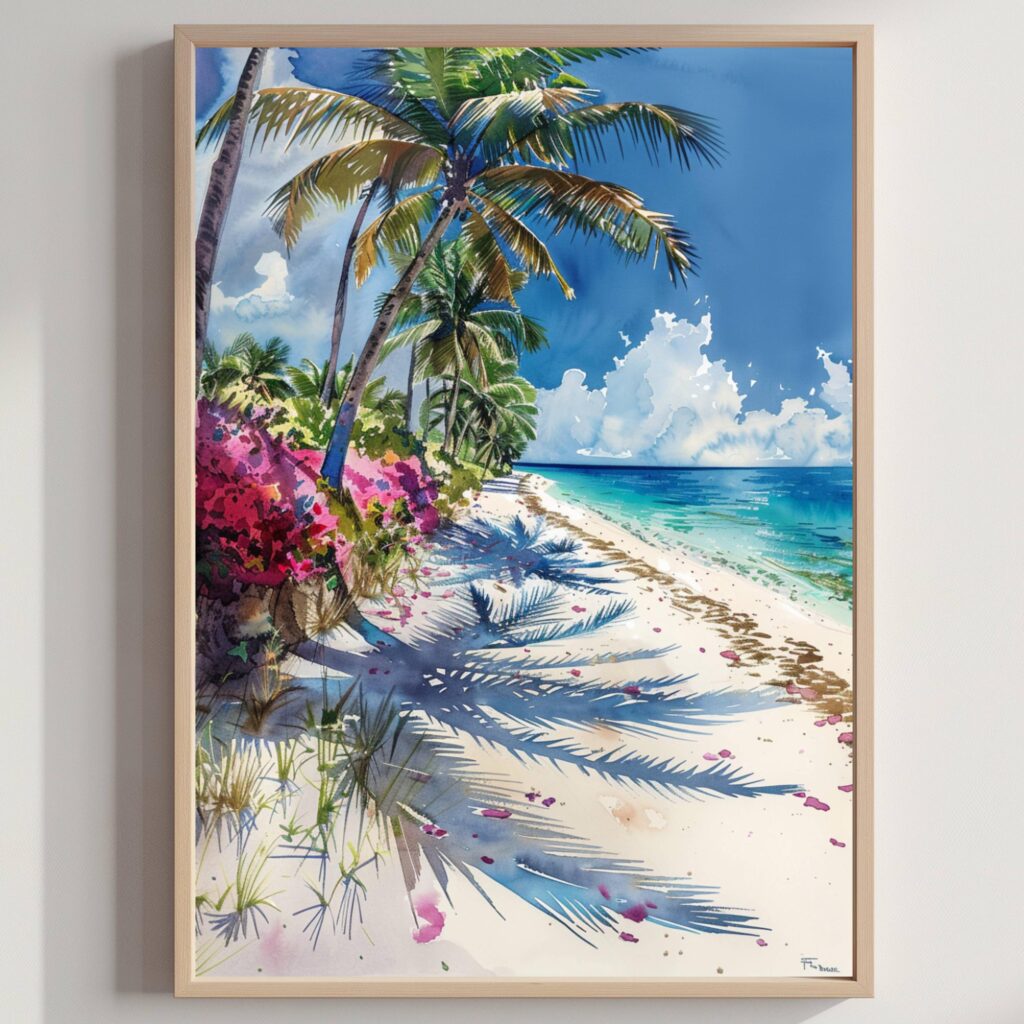
The impossibly clear, layered turquoise water of the Bahamas gives a watercolourist an almost effortlessly vivid palette to work with. We’ve captured that colour in our own The Bahamas Watercolor Print, painted first by hand and printed to order on archival paper, a small piece of the Caribbean for a wall at home.
Scattered across 700 islands with most still untouched, the Bahamas remains one of the few places where genuine, uninhabited wilderness still sits just offshore from its busiest resorts.