
The Panama Canal, connecting the Atlantic and Pacific Oceans across just 80 kilometres of isthmus, eliminates a journey around the entire tip of South America that once added weeks to shipping routes, making it one of the most consequential pieces of engineering in modern trade history. Its construction, completed in 1914 after an earlier failed French attempt collapsed under disease and financial mismanagement, cost an estimated 25,000 lives, primarily to malaria and yellow fever, before American engineers, aided by breakthrough mosquito-control research, finally completed the project.
The canal operates using a lock system that raises ships roughly 26 metres above sea level to cross the isthmus’s elevated terrain, an engineering solution still considered remarkable given the technology available at the time of its construction over a century ago.
A Canal the Country Fought to Reclaim
The United States controlled the Panama Canal Zone for decades following construction, a source of ongoing tension that culminated in the 1977 Torrijos-Carter Treaties, under which the canal was gradually transferred to full Panamanian control, completed at the end of 1999, a transition widely regarded within Panama as a defining moment of genuine national sovereignty. Panama City itself reflects that layered history directly, its Casco Viejo old town, built after pirates destroyed the original settlement in 1671, sits within view of a genuinely modern financial skyline, one of the tallest and densest in Latin America.
Panama’s position as a narrow land bridge between two continents has also made it one of the most biodiverse countries per square kilometre on Earth, home to species from both North and South American ecosystems meeting in a single, relatively small territory.
Painting a Canal Between Two Oceans
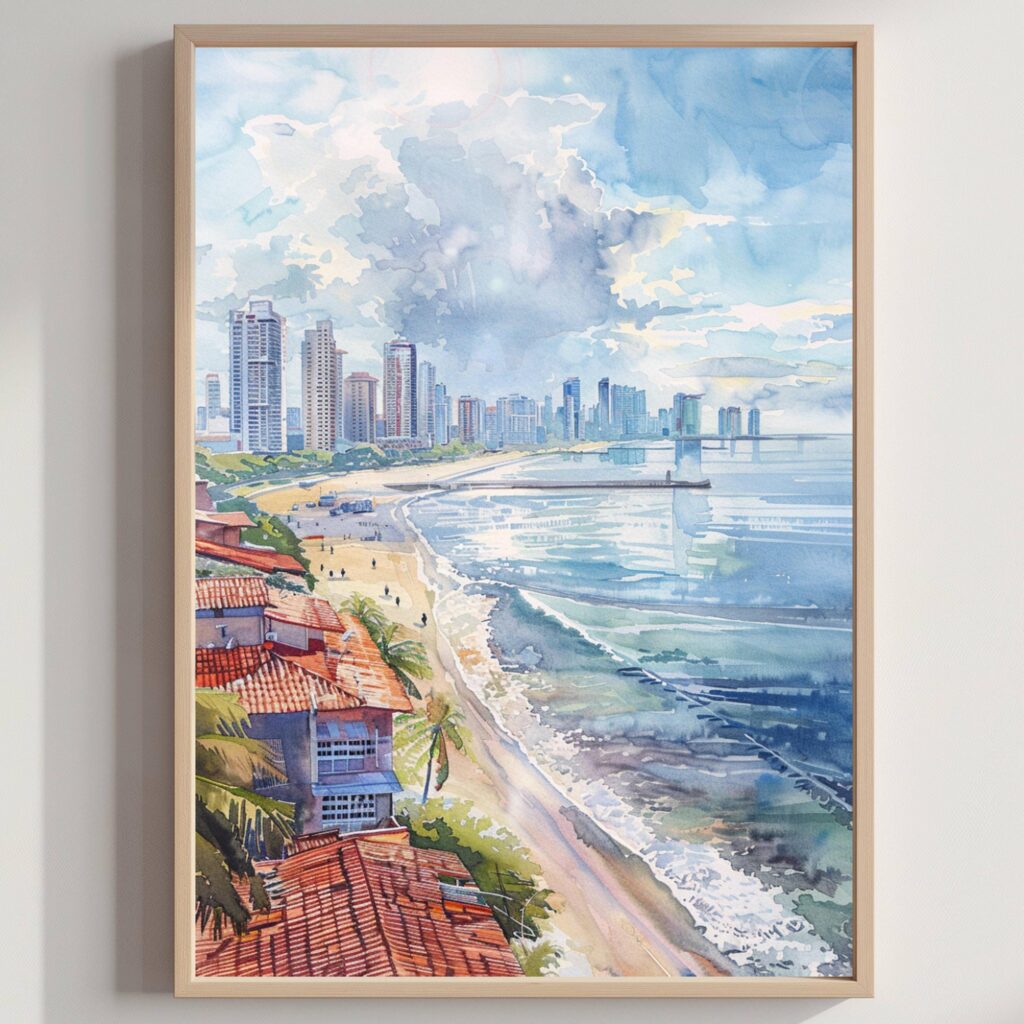
Panama’s ships passing between rainforest-lined banks gives a watercolourist a genuinely distinctive subject, engineering set against tropical landscape. We’ve captured that contrast in our own Panama Watercolor Print, painted first by hand and printed to order on archival paper, a small piece of Central America for a wall at home.
Built at enormous human cost and only fully reclaimed a quarter-century ago, the Panama Canal remains one of the rare landmarks that reshaped global trade and national identity in equal measure.