
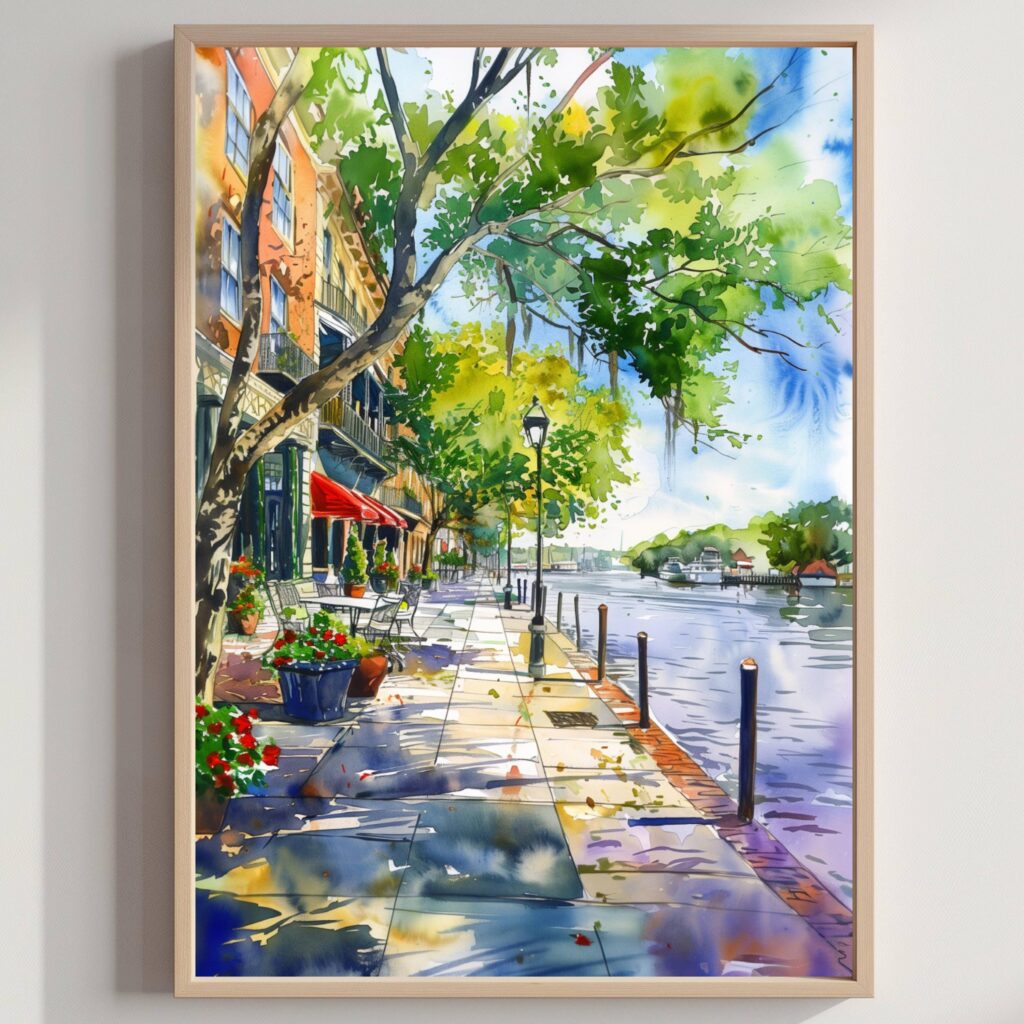
The cobblestones lining Savannah’s River Street weren’t quarried locally, they arrived as ballast in the holds of merchant ships during the 18th and 19th centuries, stones loaded in European ports to stabilise empty vessels and unloaded in Savannah once cargo was taken aboard for the return journey. Rather than being discarded, the ballast stones were repurposed to pave the riverfront, meaning the street beneath visitors’ feet today is, quite literally, built from the remnants of transatlantic trade.
Savannah itself, founded in 1733 as the capital of the Georgia colony, was laid out by General James Oglethorpe using a distinctive grid of interconnected public squares, 22 of which still survive today, a planning approach considered remarkably progressive for its era and still shaping how the city feels to walk through nearly three centuries later.
A City Spared by a Direct Request
Savannah is often credited with surviving the Civil War largely intact because Union General William Tecumseh Sherman, having completed his devastating “March to the Sea,” chose to spare the city rather than burn it, famously offering it as a Christmas gift to President Lincoln in 1864 rather than destroying it as he had much of the territory before it. That survival, whatever its true motivations, left Savannah with one of the largest urban National Historic Landmark districts in the country.
The city’s Spanish moss-draped oak trees, particularly along Forsyth Park, have become as much a symbol of Savannah as its architecture, the moss itself neither Spanish nor a true moss, but an epiphytic plant that draws moisture and nutrients from the air rather than the trees it hangs from.
Painting Old Stone and Hanging Moss
River Street’s worn ballast-stone paving and Savannah’s moss-draped oaks give a watercolourist rich texture and atmosphere to work with. We’ve captured that Southern character in our own Savannah Watercolor Print, painted first by hand and printed to order on archival paper, a small piece of Georgia for a wall at home.
Paved with stones that crossed an ocean as ballast, Savannah’s River Street remains a small, unlikely reminder of just how much old trade routes still shape a city’s ground underfoot.