
Charleston’s remarkably intact historic architecture owes a great deal to an economic downturn nobody would have wished for, the city’s plantation-based economy collapsed after the Civil War and never fully recovered in the way other Southern cities eventually did, leaving Charleston too poor for decades to tear down and modernise its historic buildings the way wealthier cities routinely did throughout the early 20th century. That poverty inadvertently preserved one of the most complete collections of 18th and 19th-century architecture in the United States.
Recognising what remained, Charleston passed the first historic preservation zoning ordinance in the United States in 1931, establishing the Board of Architectural Review to protect the city’s historic district decades before most American cities considered preservation a civic priority at all, turning what had been accidental survival into deliberate, permanent protection.
A City Built Around Its Harbour and Its History
Charleston’s harbour was the site of the first shots of the Civil War, fired on Fort Sumter in 1861, a history the city has worked increasingly to present with full historical honesty, including its central role in the American slave trade, roughly 40% of enslaved Africans brought to North America passed through Charleston’s port, a history now more directly addressed at sites like the International African American Museum, opened in 2023.
The city’s distinctive “single houses,” narrow homes built just one room wide with long side porches called piazzas, were designed specifically to maximise airflow and shade in Charleston’s hot, humid climate, a practical architectural response that also happens to define much of the historic district’s visual character today.
Painting Pastel Facades and Wrought Iron
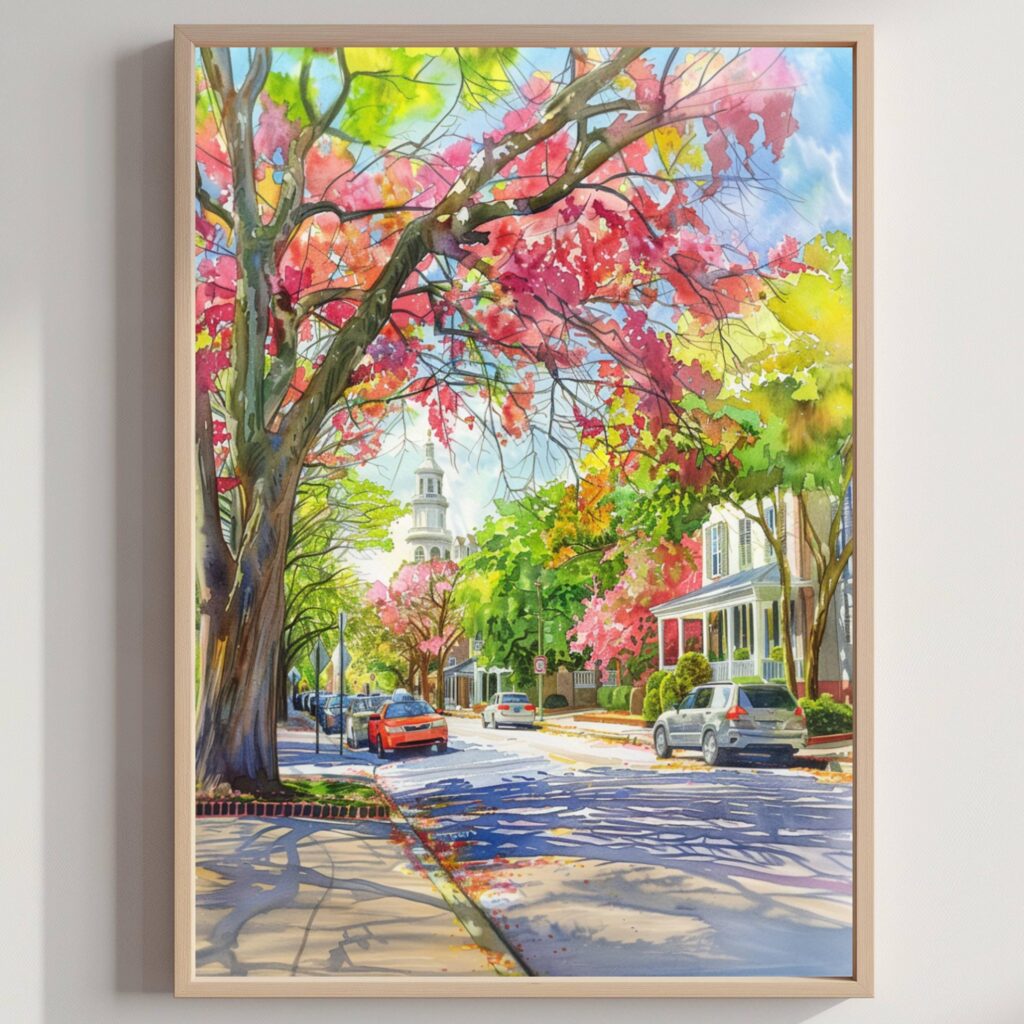
Charleston’s pastel-painted historic houses and ornate ironwork give a watercolourist warm, detailed Southern character to work with. We’ve captured that charm in our own Charleston Watercolor Print, painted first by hand and printed to order on archival paper, a small piece of South Carolina for a wall at home.
Preserved first by poverty and protected later by policy, Charleston remains a rare case of a city’s hardship accidentally becoming its greatest long-term asset.