
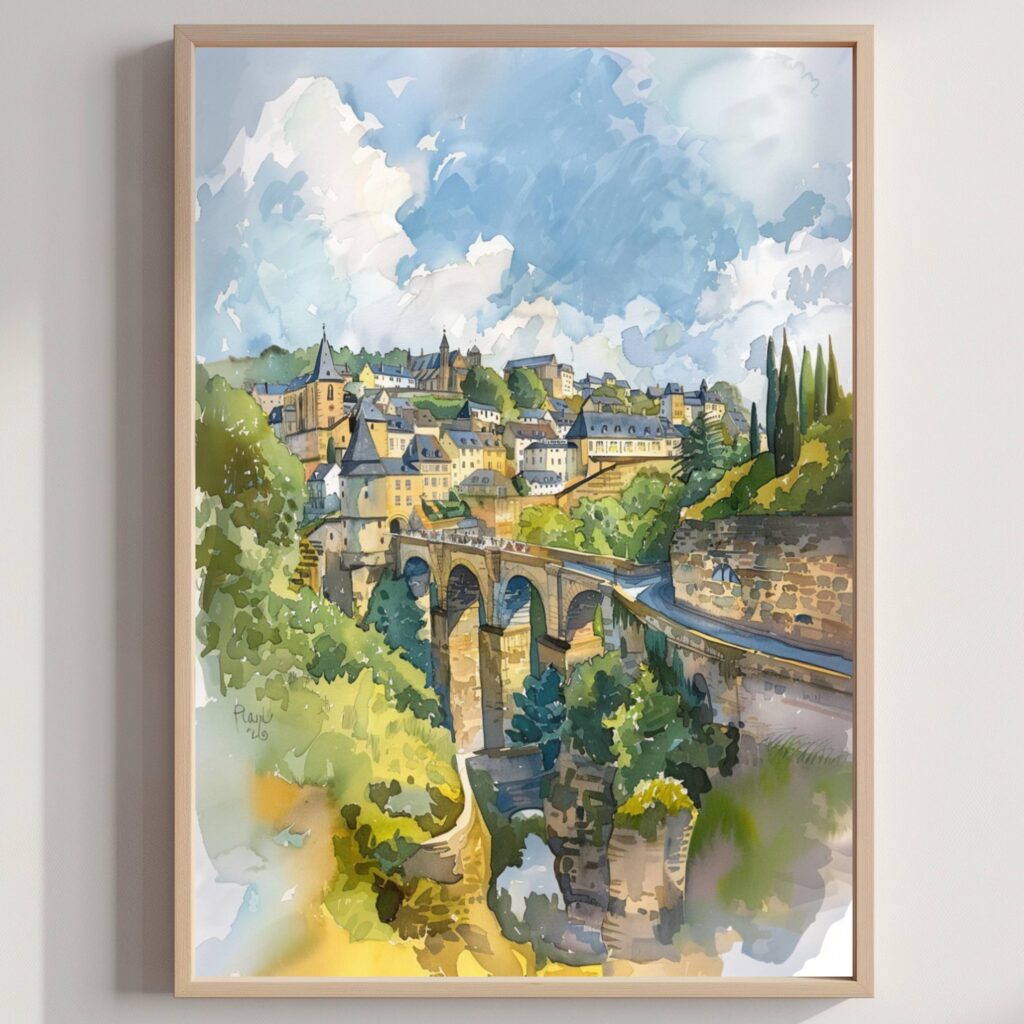
Luxembourg City is built directly around and above deep sandstone gorges carved by the Alzette and Petrusse rivers, giving the capital of one of the world’s smallest sovereign nations a dramatically layered, near-vertical geography rarely found in a city of its size. That natural defensive terrain made Luxembourg one of the most heavily fortified cities in Europe for centuries, earning it the nickname “Gibraltar of the North,” its fortifications so formidable that other European powers repeatedly fought over control of the city itself.
Much of that fortress infrastructure survives underground today, the Bock Casemates, a network of tunnels carved into the rock beginning in 1644, once housed thousands of soldiers, horses, and workshops, and visitors can still walk through several kilometres of the surviving passages beneath the old town.
Demilitarised, Then Reinvented
An 1867 treaty required Luxembourg to demolish most of its fortifications as a condition of its neutrality, a demilitarisation that transformed the city’s relationship with its own dramatic terrain, former defensive walls and bastions gradually became parks and public walkways instead. That neutral, small-nation status later positioned Luxembourg unusually well for a very different kind of influence, it became one of the founding members of the European Union and now hosts several major EU institutions, an outsized diplomatic role for a country roughly the size of a mid-sized American county.
Luxembourg is also one of the few remaining Grand Duchies in the world, a distinct form of monarchy that has given the country a continuous royal tradition since the early 19th century.
Painting a City Built Into Its Own Gorge
The dramatic layering of Luxembourg’s fortified old town above its river gorge gives a watercolourist rare vertical drama to work with. We’ve captured that layered geography in our own Luxembourg Watercolor Print, painted first by hand and printed to order on archival paper, a small piece of Europe for a wall at home.
Fortified into “Gibraltar of the North” and later disarmed into a founding EU member, Luxembourg remains proof that a country’s size has very little bearing on its influence.