
Rotterdam’s historic centre was almost entirely destroyed on a single day, May 14, 1940, when German bombing during the invasion of the Netherlands levelled roughly 25,000 buildings within hours, an event so total that post-war planners found themselves designing the city almost entirely from scratch rather than restoring what remained. Unlike Warsaw, which chose to painstakingly rebuild its historic appearance, Rotterdam made the opposite decision, embracing modern architecture and urban planning as a deliberate, forward-looking response to devastation.
That choice has made Rotterdam one of Europe’s most architecturally experimental cities, the Cube Houses, a cluster of tilted, cube-shaped homes built in the 1980s, remain among the most photographed examples of the city’s willingness to build boldly rather than conventionally.
Europe’s Largest Port, Reimagined
Rotterdam has long been home to Europe’s largest and busiest seaport, a position it held globally for decades before being overtaken by ports in Asia, its harbourside industrial heritage still visible in structures like the Van Nelle Factory, a UNESCO-listed early modernist factory building that helped define an entire school of industrial architecture. The Markthal, a striking arched food market and residential building completed in 2014, its interior ceiling covered in an enormous painted mural, exemplifies how thoroughly the city continues to treat rebuilding as an opportunity for architectural risk-taking rather than caution.
The Erasmusbrug, Rotterdam’s distinctive swan-shaped suspension bridge, has become as much a symbol of the modern city as any older landmark could have been, completed in 1996 and instantly recognisable across the Netherlands.
Painting a Skyline Built From Reinvention
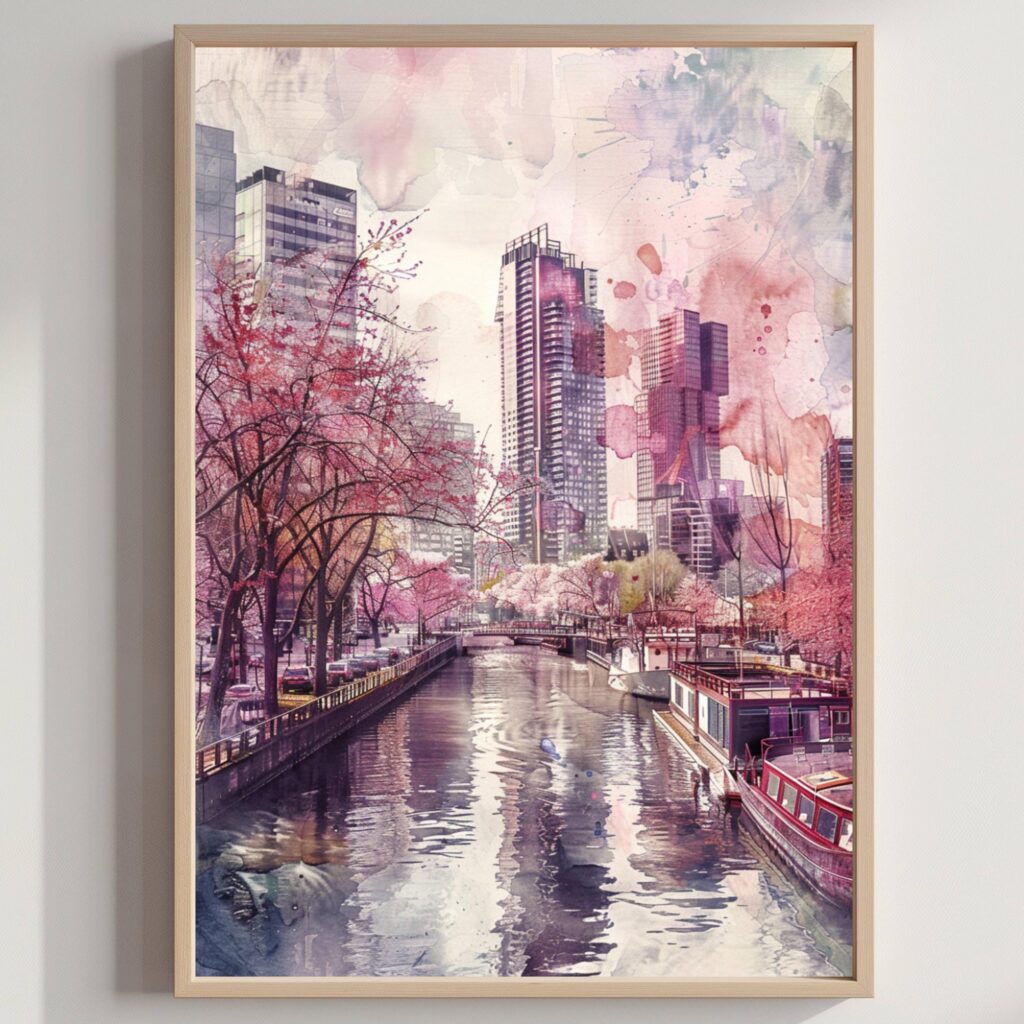
Rotterdam’s bold modern architecture against open Dutch sky gives a watercolourist unusual geometry and contrast to work with. We’ve captured that boldness in our own Rotterdam Watercolor Print, painted first by hand and printed to order on archival paper, a small piece of the Netherlands for a wall at home.
Levelled in a single day and rebuilt as something entirely new rather than restored, Rotterdam remains one of the few cities that turned catastrophic loss into a genuine architectural identity.