
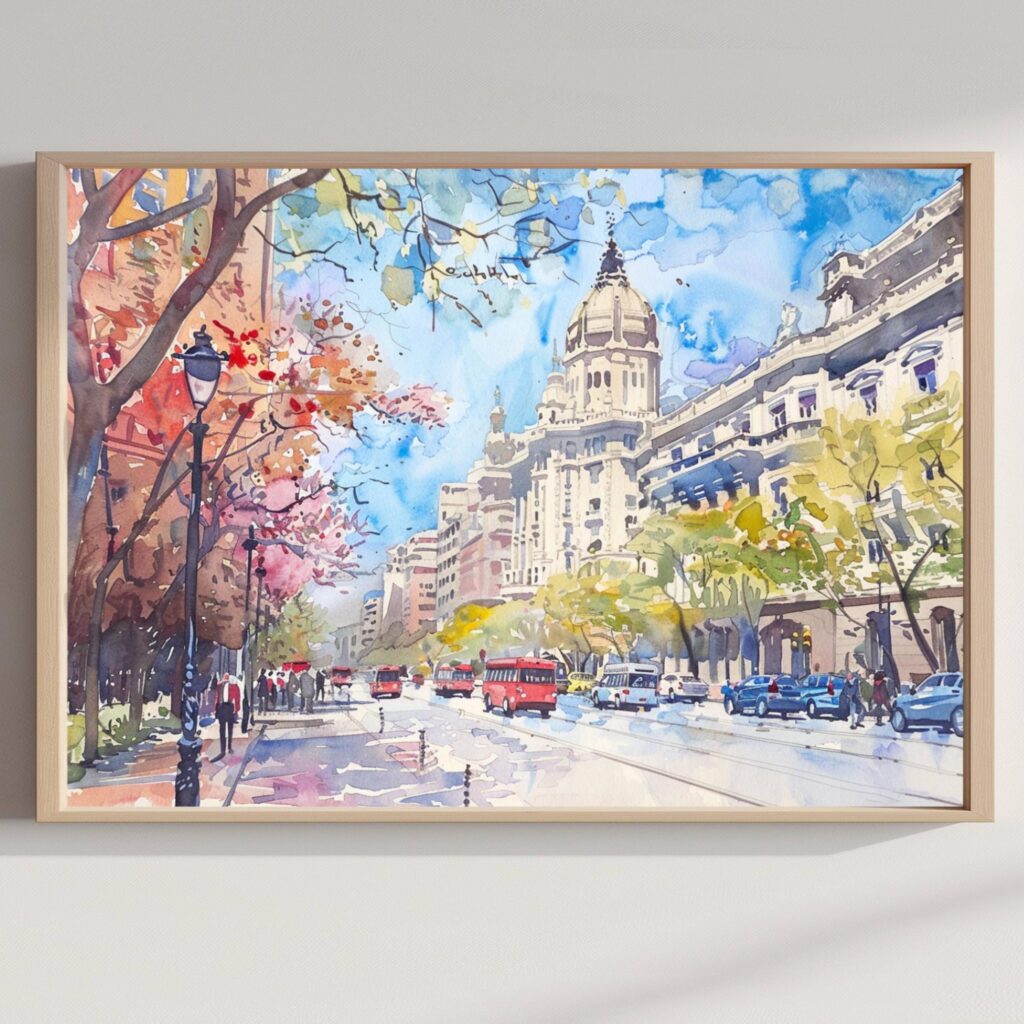
Buenos Aires earned its nickname, “the Paris of South America,” largely through deliberate design, wealthy Argentine landowners in the late 19th and early 20th centuries, flush with agricultural export wealth, commissioned French and Italian architects to remake the city in a distinctly European image, wide boulevards, Beaux-Arts facades, and grand opera houses modelled directly on Parisian originals. The Teatro Colon, the city’s opera house, is still considered one of the finest in the world acoustically, a reputation built into its very design rather than accumulated by reputation alone.
That European ambition sat alongside an entirely homegrown art form: tango, which emerged from Buenos Aires’s working-class immigrant neighbourhoods in the late 19th century, a fusion of African, European, and local musical traditions that the city’s elite initially considered scandalous before it became one of Argentina’s most celebrated cultural exports.
A City of Distinct, Fiercely Loyal Neighbourhoods
La Boca, the colourful working-class port neighbourhood where tango is said to have been born, gets its vivid, mismatched building colours from a practical origin, dockworkers historically painted their houses with leftover ship paint, whatever colours happened to be available at the time. Recoleta, by contrast, is defined by its elaborate cemetery, the final resting place of Eva Peron among others, its mausoleums so architecturally ornate that the cemetery itself functions as a genuine open-air museum.
Buenos Aires remains one of the largest Spanish-speaking cities in the world, and its residents, Portenos, maintain a cultural identity distinctly their own, shaped as much by European immigration waves as by its South American setting.
Painting Grand Boulevards and Faded Grandeur
The ornate European facades and wide, tree-lined avenues of Buenos Aires give a watercolourist elegant architectural detail to work with. We’ve captured that grandeur in our own Buenos Aires Watercolor Print, painted first by hand and printed to order on archival paper, a small piece of Argentina for a wall at home.
Built to resemble Paris and defined instead by tango born in its own streets, Buenos Aires remains a city that borrowed a style and made something entirely its own out of it.