
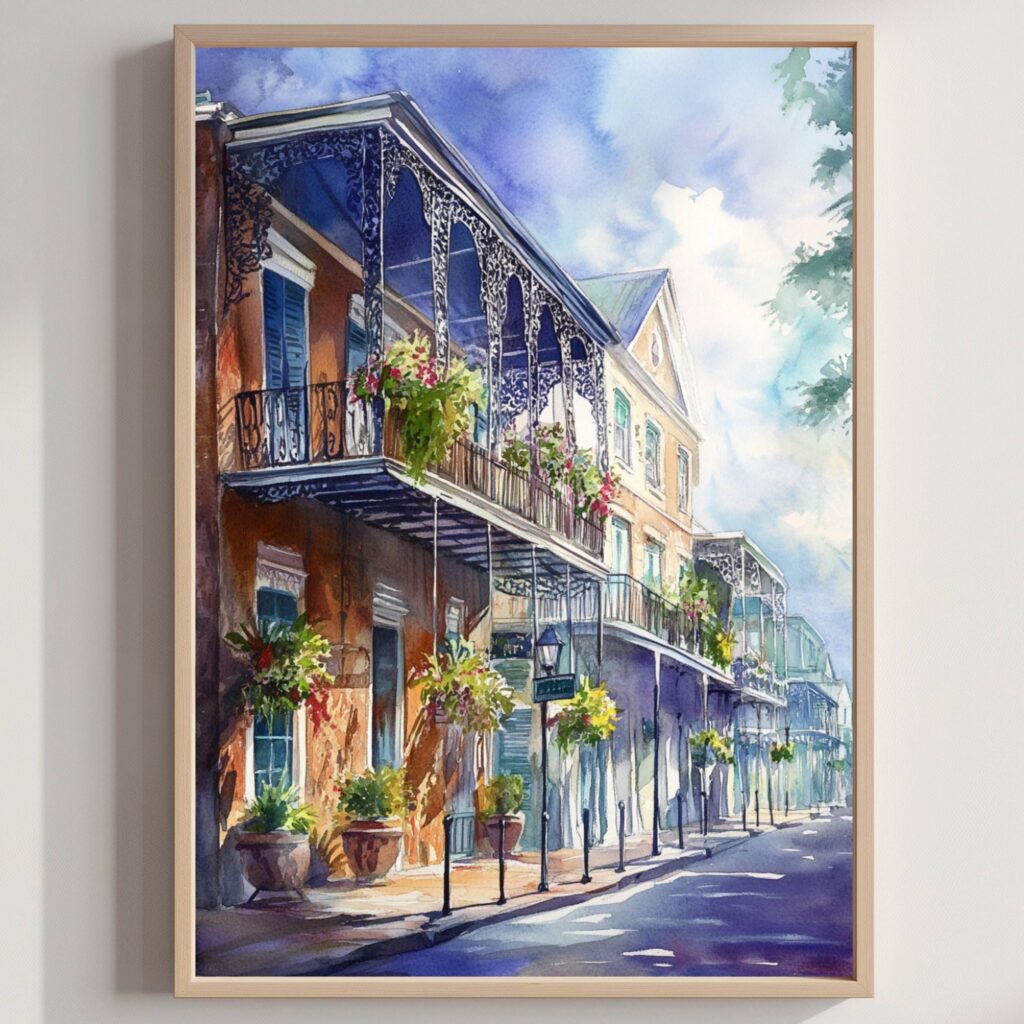
Despite its name, most of the French Quarter’s surviving architecture is actually Spanish in origin, two catastrophic fires in 1788 and 1794 destroyed much of the original French colonial building stock, and the district was rebuilt during the period Louisiana was under Spanish rule, giving it the wrought-iron balconies and courtyard architecture more typical of Spanish colonial design than French. The “French” in French Quarter refers to the neighbourhood’s founding and its enduring cultural identity rather than the buildings actually standing there today.
Jackson Square, the district’s civic heart, sits directly across from St. Louis Cathedral, the oldest continuously operating Catholic cathedral in the United States, its triple spires forming one of the most recognisable skylines in the American South, framed by street artists and musicians who have gathered in the square for generations.
A Sound the City Refuses to Let Go
The French Quarter, and New Orleans more broadly, is widely credited as the birthplace of jazz, emerging in the early 20th century from a fusion of African, Caribbean, European, and American musical traditions unique to the city’s layered cultural history. That musical identity survives today in Bourbon Street’s clubs and, perhaps more authentically, in the brass bands still playing in the streets and at the second lines, joyful parade processions that remain a genuine, living tradition rather than a tourist performance.
Hurricane Katrina in 2005 devastated much of New Orleans, but the French Quarter, built on some of the city’s highest and oldest ground, escaped the worst of the flooding, a geographic quirk that helped preserve its historic core through the disaster.
Painting Ironwork and Faded Colour
The wrought-iron balconies and pastel facades of the French Quarter give a watercolourist rich texture and warm colour to work with. We’ve captured that character in our own French Quarter Watercolor Print, painted first by hand and printed to order on archival paper, a small piece of New Orleans for a wall at home.
Named for the French, built by the Spanish, and defined by music that belongs to neither, the French Quarter remains a neighbourhood that never quite fits the label on its own street sign.