
Mauritius is permanently, if somewhat unfairly, associated with the dodo, the flightless bird that lived nowhere else on Earth and was driven to extinction within roughly a century of the island’s Dutch settlement in the 1600s, hunted and outcompeted by introduced species faster than it could adapt. Despite that grim legacy, the dodo has become something closer to a national mascot, appearing on the country’s coat of arms as a lasting symbol rather than simply a cautionary tale.
The island’s volcanic origins, formed by a hotspot beneath the Indian Ocean roughly 8 million years ago, gave it the dramatic, jagged mountain silhouettes that define much of its interior today, the peaks softened by tropical erosion into shapes strikingly different from younger volcanic islands elsewhere.
A Layered Colonial and Cultural History
Mauritius passed through Dutch, French, and finally British colonial control before gaining independence in 1968, and that layered history is visible throughout the island today, French place names, British-style left-hand driving, and a population descended from African, Indian, Chinese, and European settlers and indentured labourers, creating one of the most genuinely multicultural societies in the Indian Ocean region. Mauritian Creole, along with English and French, remains widely spoken, a linguistic reflection of that same layered past.
Chamarel’s Seven Coloured Earths, a small area of naturally striped, multicoloured volcanic soil, remains one of the island’s most photographed natural curiosities, its distinct bands of colour caused by mineral cooling variations, and famously resistant to erosion despite Mauritius’s heavy tropical rainfall.
Painting Volcanic Peaks and Turquoise Lagoons
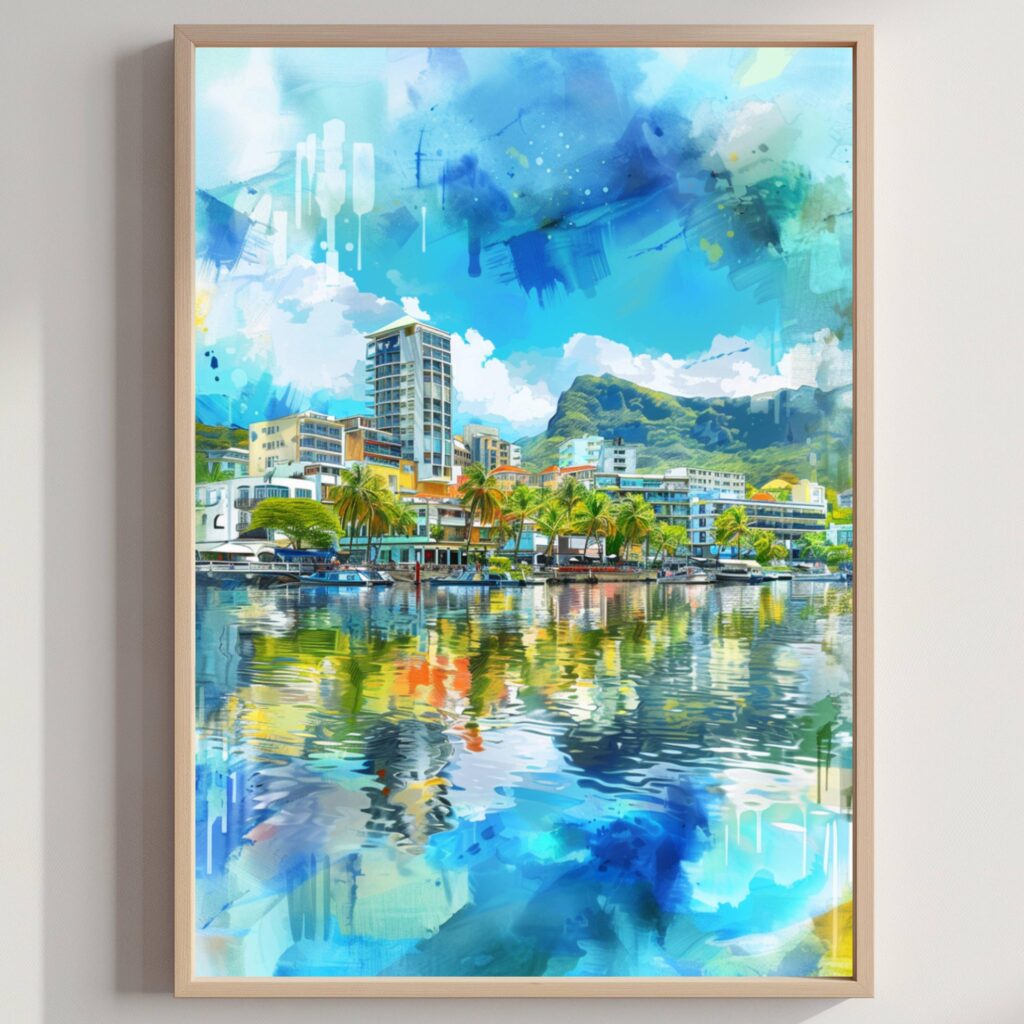
The jagged volcanic peaks rising above Mauritius’s turquoise lagoons give a watercolourist dramatic contrast between mountain and sea. We’ve captured that contrast in our own Mauritius Watercolor Print, painted first by hand and printed to order on archival paper, a small piece of the Indian Ocean for a wall at home.
Remembered worldwide for a bird it could not save, Mauritius has spent the centuries since building one of the Indian Ocean’s most genuinely layered cultures instead.