
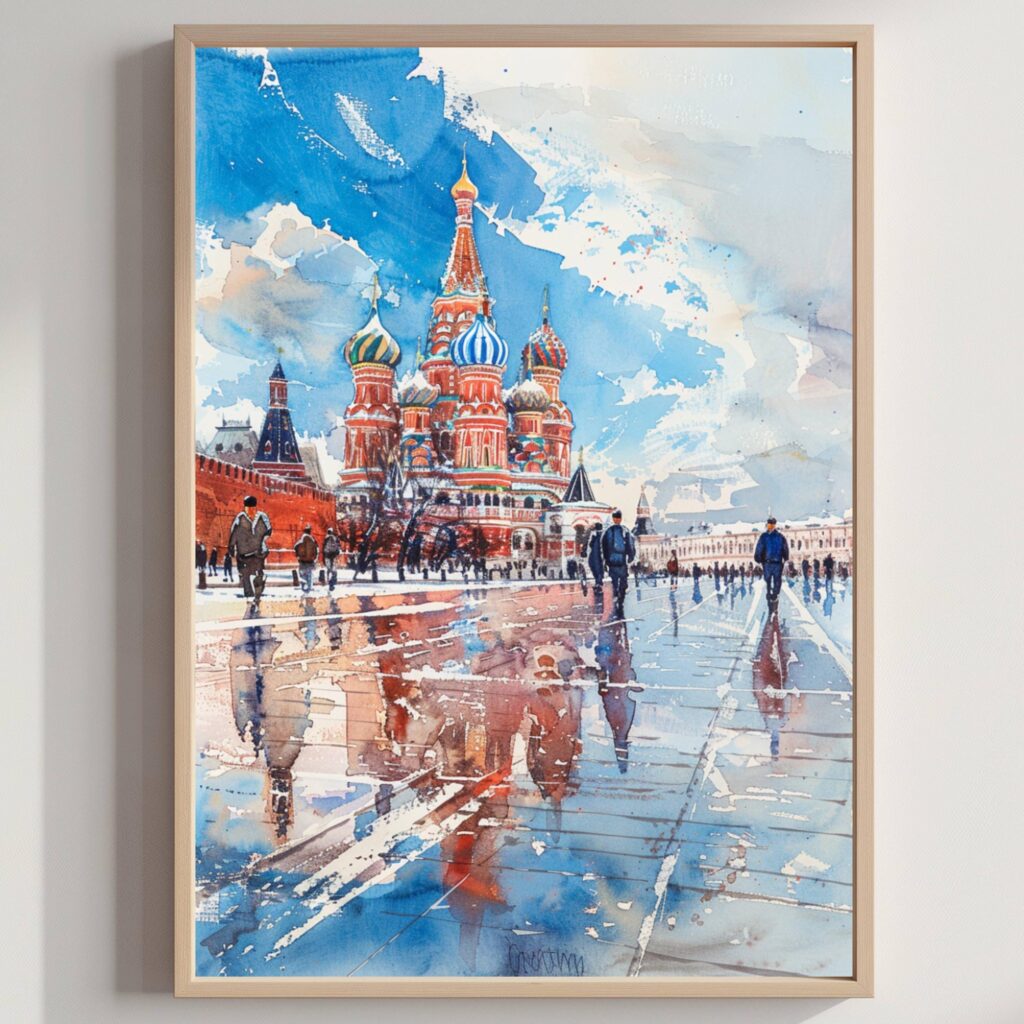
The Moscow Kremlin began as a wooden fort in the 12th century, and its current red-brick walls, built in the late 15th century under Ivan III, were constructed by Italian architects brought in specifically for their expertise in fortress design, a detail that explains why parts of the Kremlin’s defensive architecture echo contemporary Italian military engineering rather than traditional Russian styles. At roughly 2.25 kilometres of walls enclosing cathedrals, palaces, and government buildings, it remains both a functioning seat of government and one of the largest fortress complexes in Europe.
Red Square, immediately adjacent, takes its name not from Soviet symbolism but from an older Russian word, krasnaya, which historically meant “beautiful” before later also coming to mean “red,” a linguistic coincidence Soviet-era imagery later leaned into heavily.
Onion Domes and an Emperor’s Legend
Saint Basil’s Cathedral, with its riot of colourful onion domes at the edge of Red Square, was commissioned by Ivan the Terrible in the 16th century to commemorate military victory, and popular legend claims he had the architect blinded afterward to prevent an equally magnificent building ever being built again, a story most historians now consider apocryphal rather than documented fact. Each of the cathedral’s domes is uniquely patterned and coloured, no two alike, a deliberate design choice that makes the building instantly recognisable worldwide.
Moscow’s metro system, built beginning in the 1930s, was deliberately designed as much as public art as public transport, several stations feature elaborate mosaics, chandeliers, and marble columns, a Soviet-era ambition to make even daily commuting feel monumental.
Painting Domes Against Winter Sky
The saturated colour of Saint Basil’s domes against grey Moscow sky gives a watercolourist a genuinely bold, playful palette to work with. We’ve captured that colourful contrast in our own Moscow Watercolor Print, painted first by hand and printed to order on archival paper, a small piece of Russia for a wall at home.
Built first as a wooden fort and expanded by nearly every ruler since, the Kremlin remains a rare structure that has never really stopped being under construction.