
Seoul has served as Korea’s capital for over 600 years, since the Joseon dynasty established it in 1394, and Gyeongbokgung Palace, the largest of the city’s five grand palaces, remained the political heart of Korea for centuries before being severely damaged during Japanese colonial rule in the early 20th century. A major, ongoing restoration effort begun in the 1990s has painstakingly rebuilt many of the palace’s original structures, removing colonial-era buildings that had been constructed directly over parts of the complex.
That layered history sits directly alongside one of the most technologically advanced cities on Earth, Seoul was among the first cities globally to roll out widespread 5G infrastructure, and its Gangnam district, made globally famous by a single 2012 pop song, represents the hyper-modern, densely commercial counterpart to the palace district’s preserved past.
A River That Was Reclaimed, Twice
The Cheonggyecheon, a stream running through central Seoul, was paved over with a major elevated highway during the country’s rapid post-war industrialisation, only to be controversially, and expensively, restored in 2005, the highway demolished and the stream daylighted once again as a public green space. The project, widely seen as a success and a template for urban restoration projects globally, transformed a stretch of industrial infrastructure back into a walkable waterway through the heart of the financial district.
Seoul’s Hanbok rental shops, clustered near the palace district, allow visitors to wear traditional Korean dress while touring the grounds, palace entry itself often discounted or free for those wearing hanbok, a small but deliberate incentive to keep the tradition visibly present.
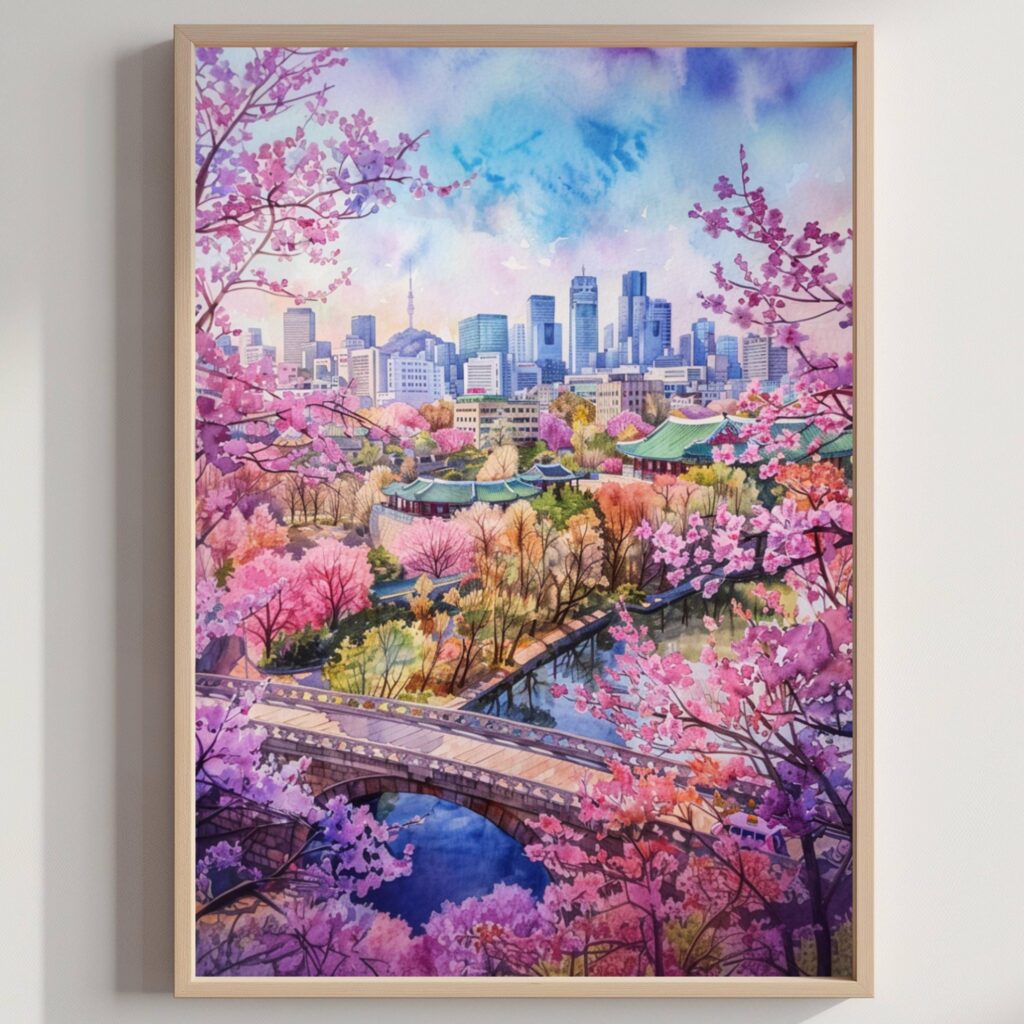
Painting Palace Roofs Against Glass Towers
The curved tile roofs of Seoul’s palaces set against the modern skyline behind them give a watercolourist a striking sense of history layered against progress. We’ve captured that contrast in our own Seoul Watercolor Print, painted first by hand and printed to order on archival paper, a small piece of South Korea for a wall at home.
Six hundred years a capital and still rebuilding what previous rulers tried to erase, Seoul remains a city that keeps choosing to restore its own past rather than pave over it for good.