
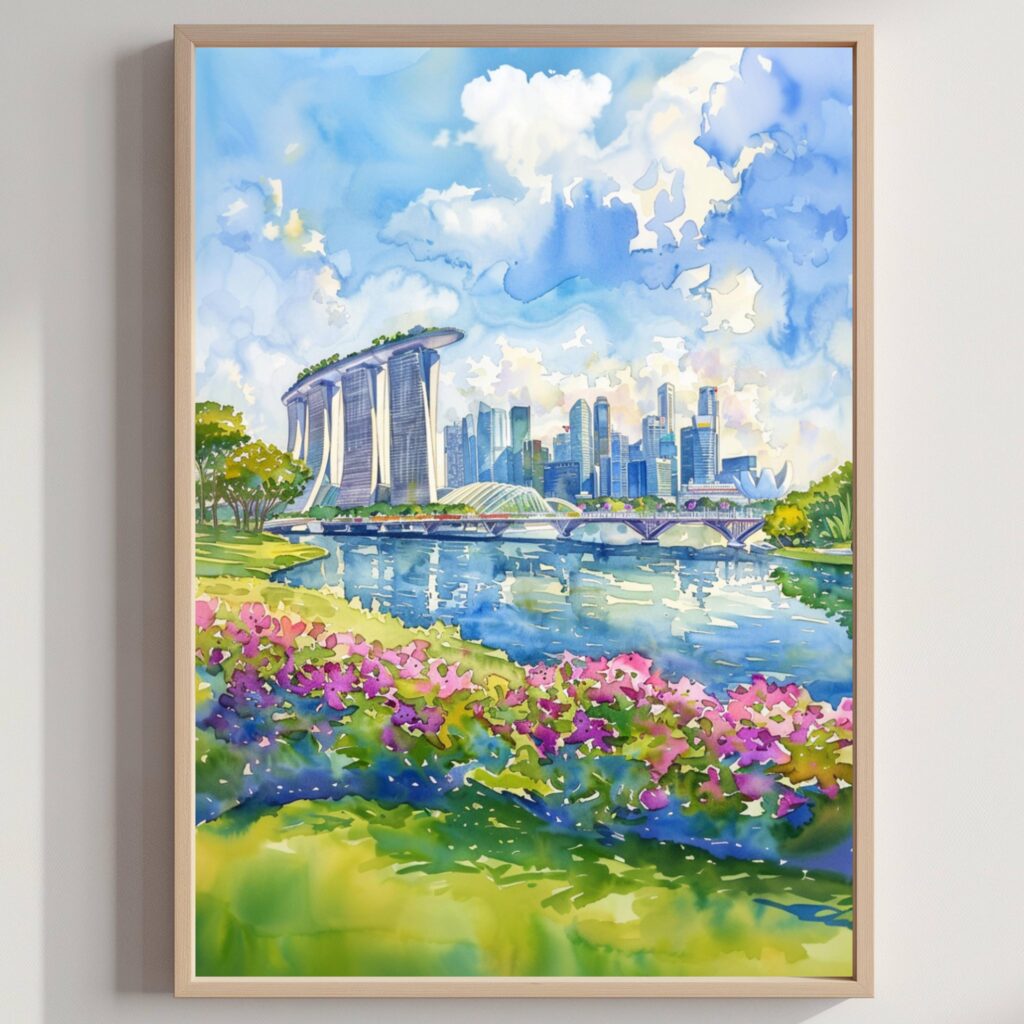
Singapore has grown by roughly 25% in physical land area since its independence in 1965, almost entirely through land reclamation, sand and earth pumped and piled into the surrounding sea to expand a city-state with essentially no natural land left to spare. That scarcity has shaped nearly every aspect of Singaporean urban planning, among the most tightly regulated and long-term-focused of any major city in the world.
Gardens by the Bay, with its towering Supertree structures, some over 16 storeys tall, exemplifies that planning philosophy directly, built on reclaimed land specifically to integrate nature into a famously dense urban environment, the Supertrees themselves doubling as vertical gardens and solar energy collectors, function disguised as sculpture.
From Swamp to Global Financial Hub
At independence, Singapore had no natural resources, minimal freshwater, and a per capita income lower than many of its regional neighbours, its transformation into one of the world’s wealthiest nations within a single generation is frequently cited as among the most dramatic economic turnarounds of the 20th century, driven by deliberate policy rather than natural advantage. Singapore’s strict laws, famously including bans on chewing gum sales, are often mocked internationally but reflect a broader governing philosophy prioritising order and cleanliness that residents largely credit for the city’s remarkably low crime rate.
Despite its density, Singapore has committed to becoming a “City in a Garden,” mandating green space and vertical planting in new developments, an approach increasingly studied by other rapidly urbanising cities worldwide.
Painting a Garden City’s Skyline
The interplay of Singapore’s futuristic architecture and deliberately integrated greenery gives a watercolourist a genuinely distinctive cityscape to work with. We’ve captured that balance in our own Singapore Watercolor Print, painted first by hand and printed to order on archival paper, a small piece of Southeast Asia for a wall at home.
Built without natural resources and largely without natural land, Singapore has spent sixty years proving that neither was ever really the limiting factor.