
The Brooklyn Bridge’s designer, John Augustus Roebling, never saw it built. He died of tetanus in 1869 after a ferry accident crushed his foot while he was surveying the bridge’s location, just as construction was about to begin. His son, Washington Roebling, took over as chief engineer, only to be severely disabled himself by decompression sickness, “the bends,” from working in the pressurised caissons used to dig the bridge’s foundations beneath the East River, a condition barely understood by medicine at the time.
Confined to his home for years afterward, Washington Roebling continued directing construction by watching the bridge through a telescope and relaying detailed instructions through his wife, Emily Warren Roebling, who taught herself advanced engineering and effectively managed day-to-day construction, making her arguably as responsible for the bridge’s completion in 1883 as either Roebling man.
The Longest Suspension Bridge the World Had Seen
When it opened, the Brooklyn Bridge was the longest suspension bridge in the world, and the first to use steel, rather than iron, for its structural cables, a material choice that helped set the standard for major suspension bridges built afterward. Just six days after opening, a rumour that the bridge was collapsing triggered a panicked stampede that killed twelve people, prompting P.T. Barnum to lead 21 elephants across it the following year specifically to publicly demonstrate its safety.
An estimated 27 workers died during construction, a toll that was, grimly, considered relatively low for a major infrastructure project of that era and scale.
Painting Steel Against the Skyline
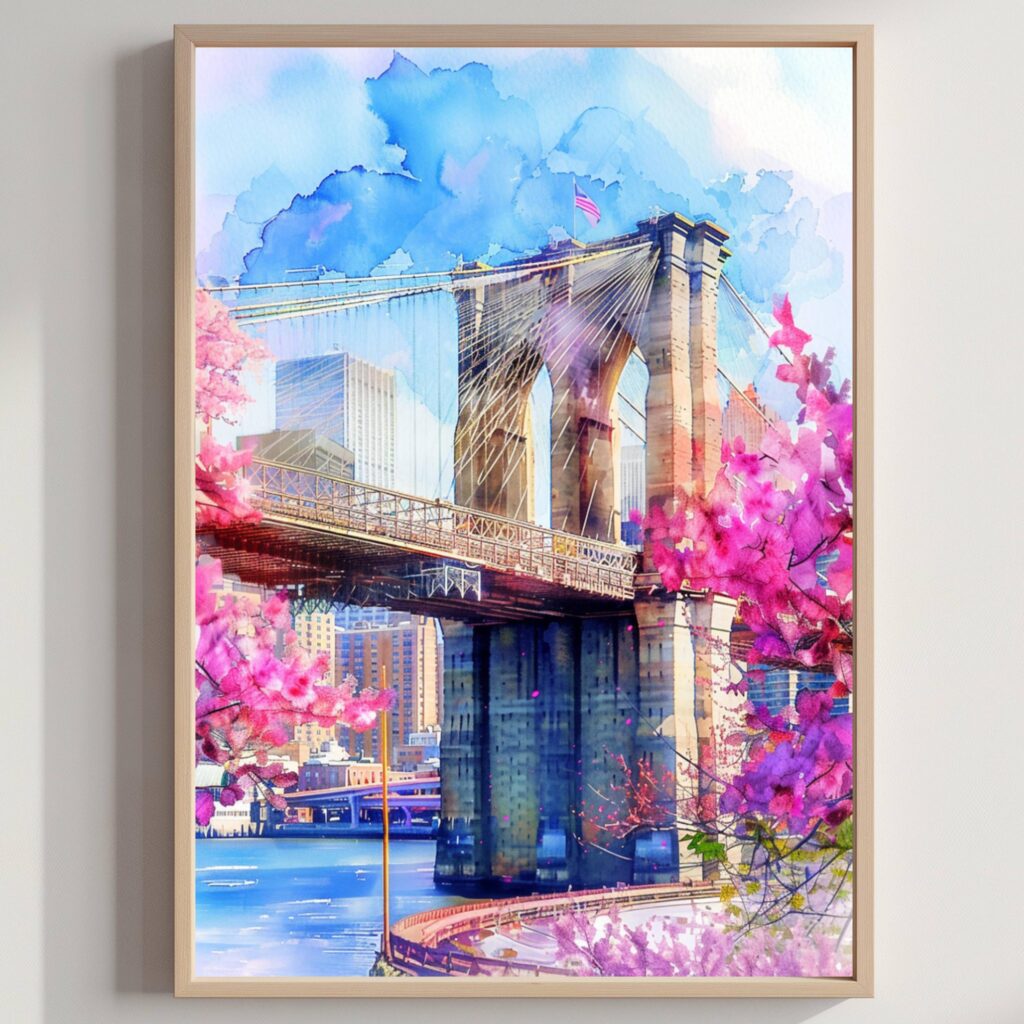
The bridge’s Gothic stone towers and web of steel cables, framed against the Manhattan skyline, give a watercolourist striking geometry and scale to work with. We’ve captured that ironwork drama in our own Brooklyn Bridge Watercolor Print, painted first by hand and printed to order on archival paper, a small piece of New York for a wall at home.
Completed by a disabled engineer directing work through a telescope and a wife who taught herself the mathematics to finish it, the Brooklyn Bridge stands as much as a monument to persistence as to engineering.