
Bali’s famous rice terraces are managed through subak, a cooperative irrigation system dating back to at least the 9th century, in which local farmer communities collectively govern water distribution across interconnected paddies, a democratic system so effective and ecologically balanced that UNESCO recognised it as a Cultural Landscape in 2012. The terraces themselves, carved into steep volcanic hillsides, follow the natural contours of the land rather than imposing a grid, each field dependent on cooperation with its neighbours to function at all.
That cooperative philosophy, Tri Hita Karana, roughly “three causes of well-being,” balancing harmony between people, nature, and the spiritual world, underpins much of Balinese Hindu culture, distinct from the Islam practised across most of the rest of Indonesia, a religious and cultural island within a much larger archipelago.
A Landscape Shaped by Volcanoes
Bali’s fertile soil, which makes its rice terraces and lush landscape possible, comes directly from Mount Agung and Mount Batur, active volcanoes whose periodic eruptions have enriched the island’s earth for millennia, even as they remain a genuine ongoing hazard, Agung’s major 2017-2019 eruption period displaced tens of thousands of residents. Water temples scattered throughout the terraced landscape aren’t just religious sites but function as the literal control points of the subak irrigation network, spirituality and infrastructure operating as the same system.
Tourism has grown enormously since the 1970s, concentrated largely in the island’s south, while the terraced highlands around Ubud and Jatiluwih remain closer to the agricultural rhythm that has shaped Balinese life for over a thousand years.
Painting Green Terraces in Tropical Light
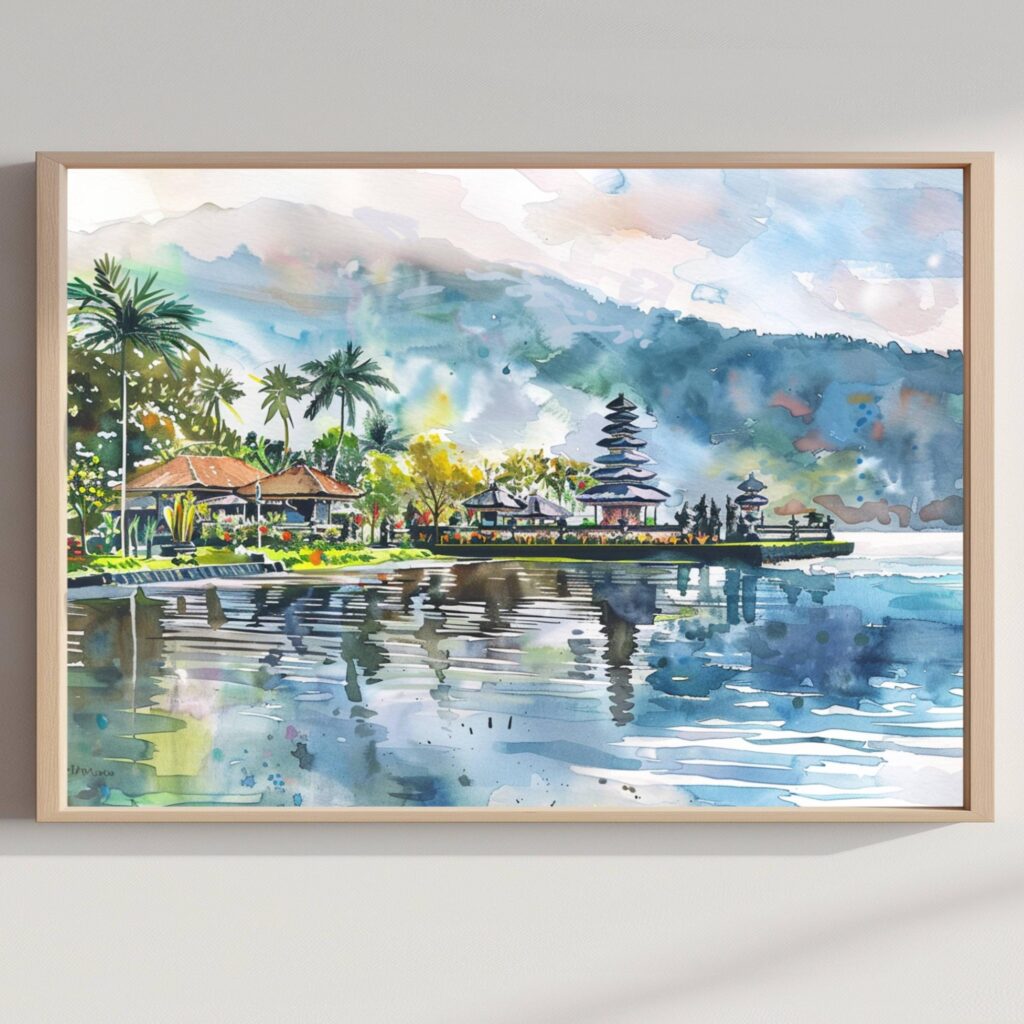
The layered green of Bali’s rice terraces, catching tropical light and reflected water, gives a watercolourist rare texture and rhythm to work with. We’ve captured that layered landscape in our own Bali Watercolor Print, painted first by hand and printed to order on archival paper, a small piece of Indonesia for a wall at home.
Farmed cooperatively for over a thousand years and shaped by volcanoes that still occasionally interrupt it, Bali’s terraced landscape remains one of the rare places where beauty and function were never really separate ideas.