
Amsterdam is built almost entirely on land reclaimed from marsh and water, and much of the historic centre stands on wooden piles driven deep into the soft ground, some buildings supported by thousands of individual poles, a foundation technique that has kept the city standing since the medieval period despite sitting largely below sea level. The Royal Palace on Dam Square alone rests on nearly 13,700 wooden piles, a scale of hidden engineering most visitors never think to look for beneath their feet.
The city’s canal ring, Grachtengordel, was planned in the 17th century during Amsterdam’s Golden Age as a coordinated urban expansion, three main concentric canals designed together for drainage, transport, and defence, an ambitious piece of city planning now recognised as a UNESCO World Heritage Site and still largely intact more than 400 years later.
More Bicycles Than People
Amsterdam is home to more bicycles than residents, an estimated 880,000 bikes for a population of roughly 870,000, and cycling infrastructure that has been deliberately expanded since the 1970s, when public protests against car-dominated urban planning pushed the city toward the bike-first design it’s now famous for. Canal-side houses, meanwhile, are famously narrow, a consequence of historic property taxes once based on street frontage width, leading residents to build tall, deep, and narrow rather than wide.
Many of those narrow buildings tilt forward slightly by design, a deliberate lean that made it easier to hoist furniture up to higher floors using an external hook, since the staircases inside were often too narrow and steep for large items.
Painting Canals in Reflected Light
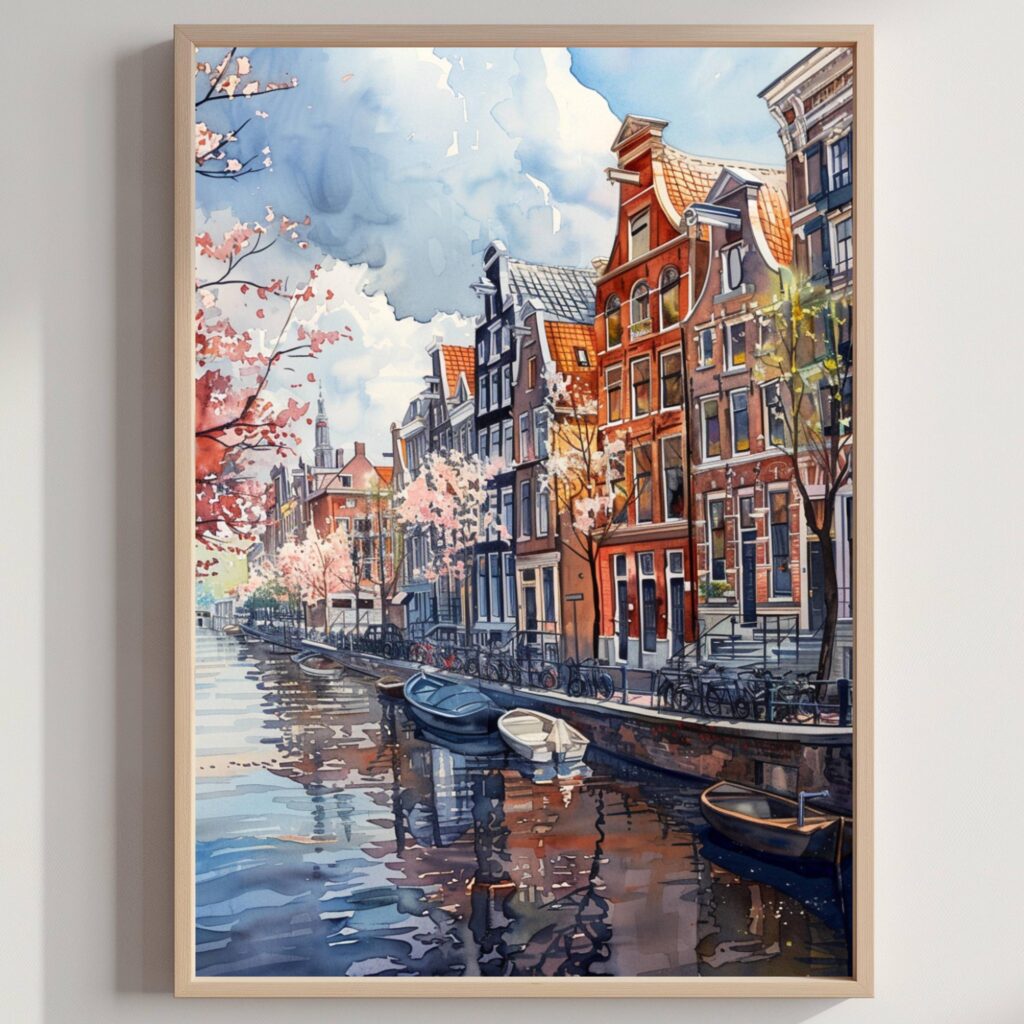
The narrow gabled houses and still canal water of Amsterdam give a watercolourist reflection and architectural rhythm to work with in equal measure. We’ve captured that canal-side calm in our own Amsterdam Watercolor Print, painted first by hand and printed to order on archival paper, a small piece of the Netherlands for a wall at home.
Built on wooden poles in land that was never meant to hold a city, Amsterdam has spent four centuries proving that determined engineering beats geography most of the time.