
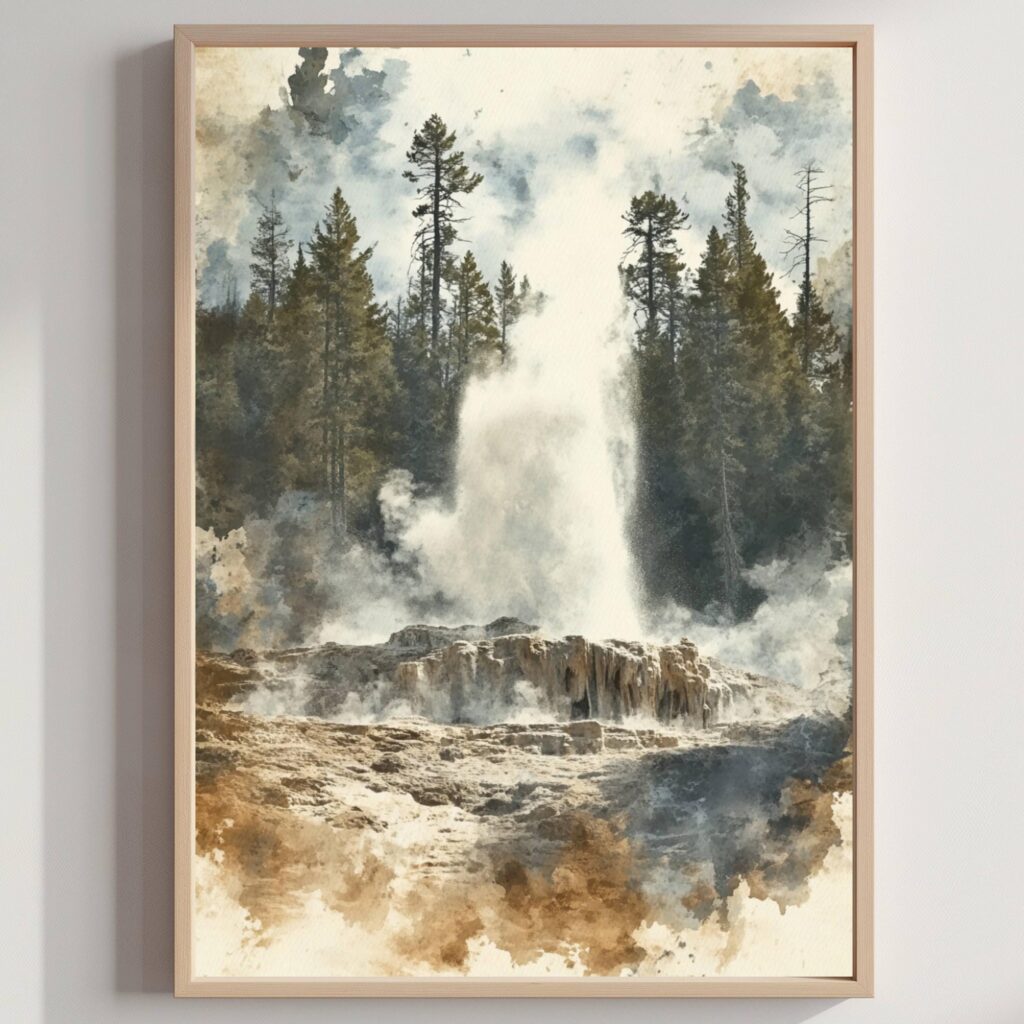
Yellowstone was established in 1872 as the world’s first national park, decades before the concept existed anywhere else, protecting a landscape so geologically unusual that early explorers’ reports of boiling rivers and spouting geysers were initially dismissed back east as tall tales. What those explorers had actually found was the surface expression of one of the largest active volcanic systems on Earth, a supervolcano whose massive underground magma chamber powers the park’s roughly 10,000 geothermal features.
Old Faithful, the park’s most famous geyser, has erupted reliably every 44 to 125 minutes since records began, its predictability, rare among geysers, made it the centrepiece of Yellowstone tourism almost from the park’s founding, drawing crowds to watch water and steam blast up to 55 metres into the sky.
Wolves, Wiped Out and Brought Back
Grey wolves were hunted to local extinction within Yellowstone by the 1920s, a decision later understood to have had cascading ecological consequences, elk populations exploded, overgrazing riverside vegetation and altering the landscape itself. Their reintroduction in 1995, using wolves captured in Canada, became one of the most studied examples of a “trophic cascade” in modern ecology, wolf predation reduced elk numbers, vegetation recovered, and even the park’s rivers changed course as a result.
The park’s supervolcano last had a major eruption roughly 640,000 years ago, and while scientists monitor it continuously, current data suggests no eruption is imminent, the geysers and hot springs are simply the volcano’s slow, steady exhale.
Painting Steam and Stone
The mineral-streaked terraces and rising steam of Yellowstone’s geothermal features give a watercolourist unusual texture and atmosphere to capture. We’ve painted that quiet volcanic drama in our own Yellowstone Watercolor Print, printed to order on archival paper, a small piece of Wyoming for a wall at home.
Sitting atop one of the planet’s largest volcanic systems, Yellowstone has spent 150-plus years as a national park quietly reminding visitors just how much is happening beneath their feet.