
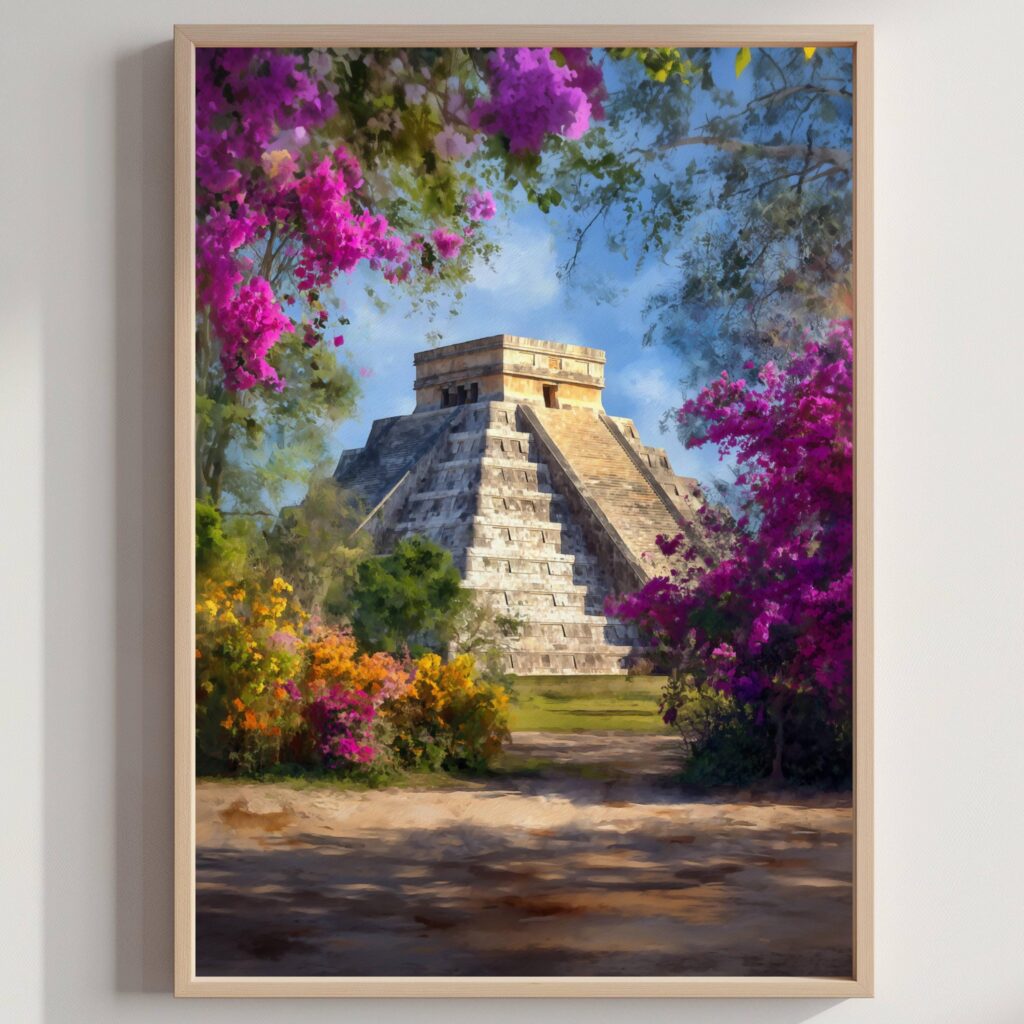
El Castillo, the great step pyramid at the centre of Chichen Itza, is an astronomical instrument as much as a temple. Built by the Maya sometime between the 9th and 12th centuries, it has 91 steps on each of its four sides, plus the top platform, totalling 365, one for every day of the solar year, a calendar built directly into its architecture rather than recorded separately from it.
Twice a year, at the spring and autumn equinoxes, the setting sun casts a shadow along the pyramid’s northern staircase that appears to form the body of a serpent, slithering down to meet a carved stone serpent head at the base, a deliberate effect representing Kukulkan, the feathered serpent deity, that still draws thousands of visitors to witness it.
A City That Blended Two Cultures
Chichen Itza’s architecture shows clear influence from both the Maya and the Toltec people of central Mexico, evident in features like the Temple of the Warriors and its rows of carved columns, a style rarely seen at other Maya sites. Historians believe the city became a major cultural and political crossroads for centuries, its population and influence peaking long before the region’s later cities that Spanish conquistadors would eventually encounter.
The site’s Great Ball Court, the largest in ancient Mesoamerica, was built for a ritual ball game whose exact rules remain uncertain, though carved reliefs suggest the losing team, or possibly the winners, faced ritual sacrifice, a detail that still unsettles modern visitors walking its stone terraces.
Painting a Pyramid Built From Sunlight
The sharp geometry of El Castillo against the flat Yucatan jungle horizon offers a watercolourist bold shape and dramatic shadow to work with. We’ve captured that stark silhouette in our own Chichen Itza Watercolor Print, painted first by hand and printed to order on archival paper, a small piece of the Yucatan for a wall at home.
Built to mark the turning of the year with nothing but sunlight and shadow, Chichen Itza remains one of the rare monuments that still performs the exact function it was designed for, on schedule, twice every year.