
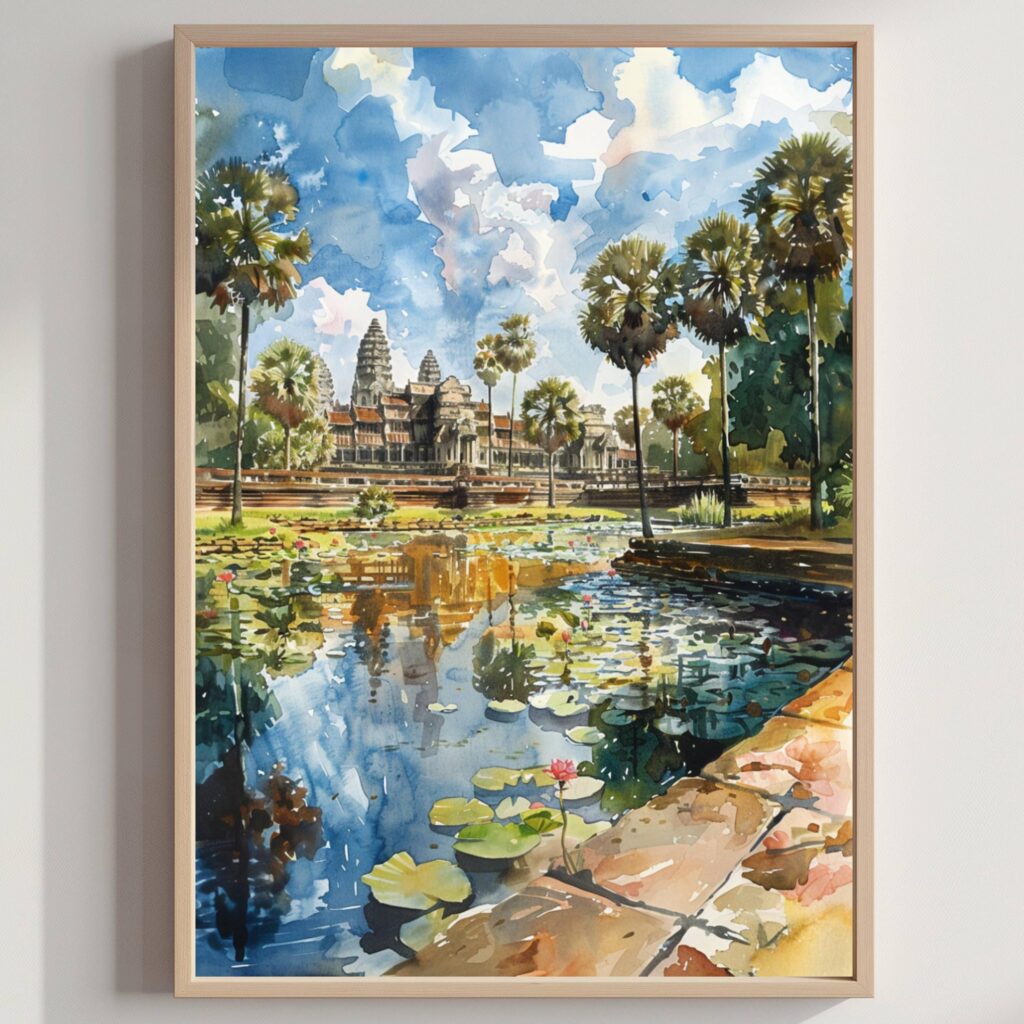
Angkor Wat was built in the early 12th century by King Suryavarman II as a state temple, originally dedicated to the Hindu god Vishnu, before gradually transforming into a Buddhist site over subsequent centuries, a shift in faith that left both traditions layered visibly throughout its carvings today. It remains the largest religious monument in the world by land area, its outer wall and moat enclosing roughly 162 hectares, an area larger than many small towns.
The temple’s design wasn’t arbitrary, its layout was built to represent Mount Meru, the mythical centre of the universe in Hindu and Buddhist cosmology, with its central towers symbolising the mountain’s peaks and the surrounding moat representing the cosmic ocean. Its walls are covered in nearly 2 kilometres of intricate bas-relief carvings depicting Hindu epics and historical battles, among the longest continuous stone carvings anywhere in the world.
Never Actually Lost
Despite the popular Western narrative of Angkor Wat as a “lost city” rediscovered by French explorer Henri Mouhot in 1860, the temple had never truly been abandoned, Buddhist monks maintained a continuous presence there for centuries, and it remained a site of active pilgrimage and local significance throughout. Mouhot’s writings simply introduced it to European audiences, who mistook local continuity for their own act of discovery.
Today Angkor Wat appears on Cambodia’s national flag, one of the only national flags in the world to feature a real building rather than a symbolic or abstract emblem, a measure of how central the temple remains to national identity.
Painting Stone at Sunrise
Angkor Wat’s silhouette against the dawn sky, reflected in its surrounding moat, is one of the most quietly dramatic sights in religious architecture, and a natural subject for watercolour’s soft early light. We’ve captured that reflected stillness in our own Angkor Wat Watercolor Print, painted first by hand and printed to order on archival paper, a small piece of Cambodia for a wall at home.
Never truly lost, only newly noticed by the wider world, Angkor Wat has spent nine centuries being exactly what it was built to be: a mountain in stone, still watched over by those who never stopped believing in it.