
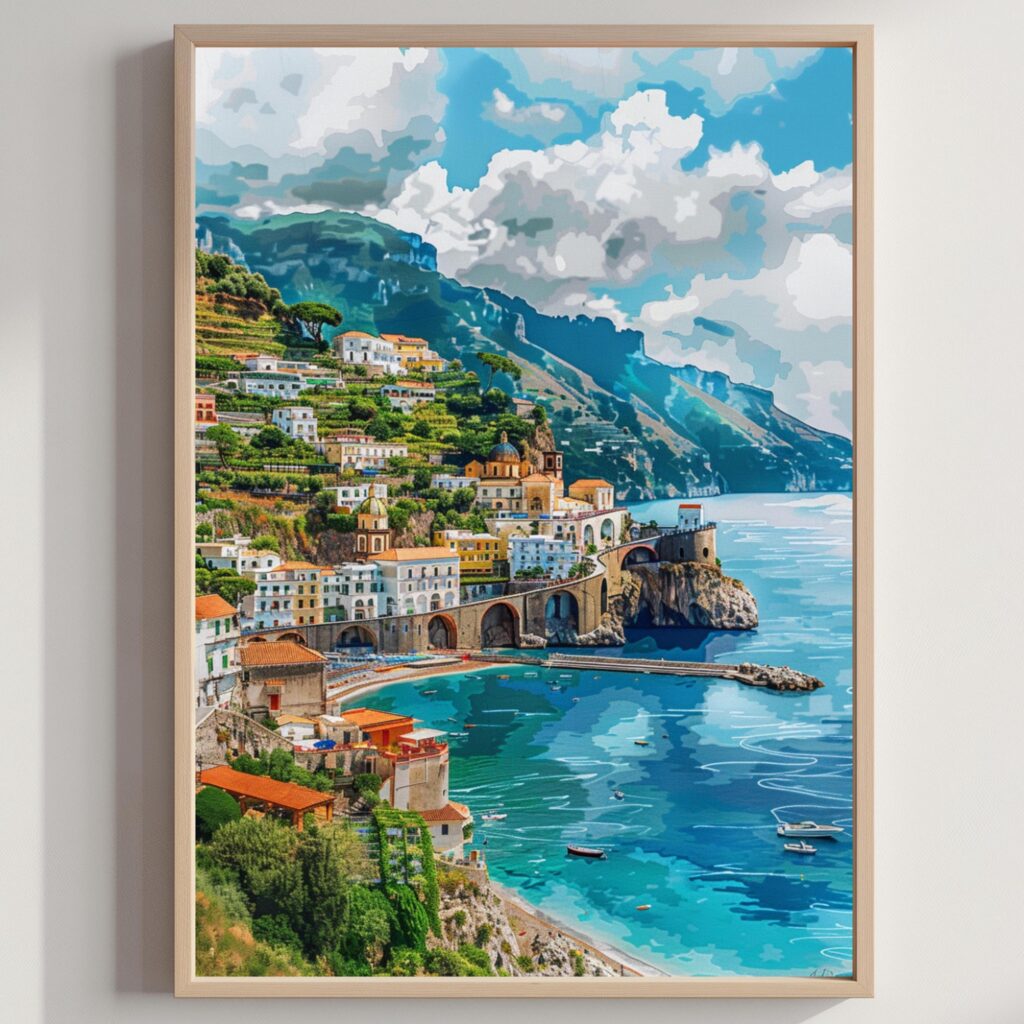
The Amalfi Coast’s defining feature, the road, is almost as famous as the scenery it runs through. The Strada Statale 163, completed in the 1850s, winds for roughly 50 kilometres along near-vertical cliffs above the Tyrrhenian Sea, threading through tunnels and around blind corners with a steep drop on one side for nearly its entire length. Engineers of the era considered it one of the more ambitious road-building projects in southern Italy, carved into terrain that had kept the coast relatively isolated for centuries.
That isolation shaped the towns strung along it, Positano, Amalfi, and Ravello among them, into vertical settlements, pastel-coloured houses stacked up hillsides too steep to build on any other way. Amalfi itself gave its name to the entire coastline and was, in the medieval period, a maritime power in its own right, one of Italy’s four historic maritime republics, trading across the Mediterranean centuries before tourism ever discovered it.
Lemons, Limoncello, and Terraced Slopes
The coast’s steep terraces aren’t just scenic, they’re agricultural, generations of local farmers have cultivated Sfusato Amalfitano lemons on hillside groves too steep for machinery, harvested largely by hand and turned into limoncello, the coast’s signature liqueur. Those same terraces, reinforced by dry stone walls built without mortar, have withstood erosion and landslides for centuries through nothing more than careful, continuous maintenance.
Positano in particular transformed from a quiet fishing village into an international symbol of Italian glamour largely after a 1953 essay by John Steinbeck introduced it to American readers, a single piece of writing that reshaped the town’s fortunes almost overnight.
Painting a Coastline on a Slope
The stacked, sun-bleached houses and deep blue water of the Amalfi Coast give a watercolourist a striking sense of vertical drama to work with. We’ve captured that steep, sunlit geometry in our own Amalfi Coast Watercolor Print, painted first by hand and printed to order on archival paper, a small piece of southern Italy for a wall at home.
Built along a road that shouldn’t, by any reasonable engineering logic, have been easy to construct, the Amalfi Coast remains proof that difficult terrain and dramatic beauty tend to arrive together.