
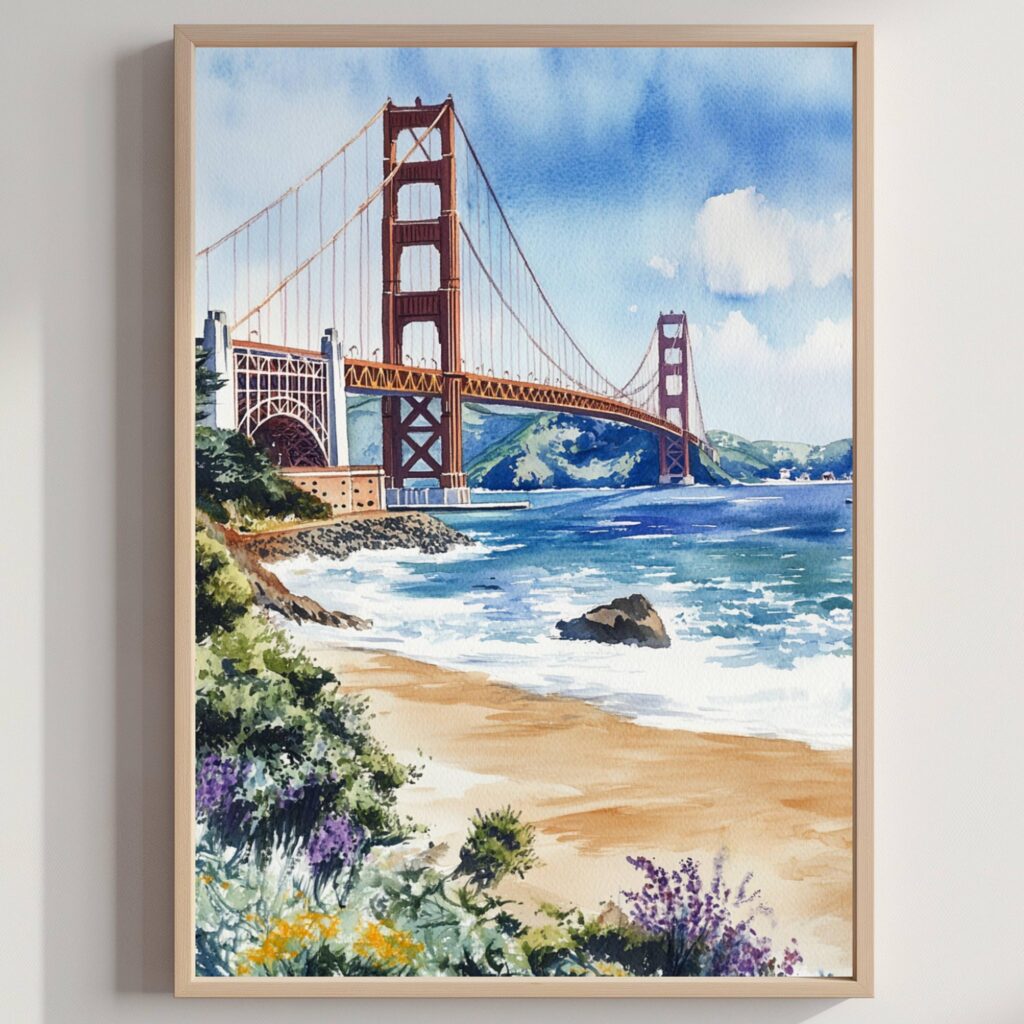
When it opened in 1937, the Golden Gate Bridge was the longest and tallest suspension bridge in the world, a title it held for nearly three decades. Engineers of the era had widely doubted it could be built at all across the strait’s notorious currents, fog, and winds. Joseph Strauss, the bridge’s chief engineer, spent over a decade convincing sceptics before construction even began, and the finished structure remains one of the most photographed pieces of infrastructure on the planet.
Its colour has its own quiet history: “International Orange” was chosen not for visibility in the fog, as many assume, but because the Navy and Air Force originally wanted it painted in black and yellow stripes for shipping visibility. The architect Irving Morrow preferred the warmer orange primer the steel already arrived in, and fought to keep it, a decision now inseparable from the bridge’s identity.
Built for Wind, Fog, and Earthquakes
The bridge’s setting is as demanding as any in the world: the Golden Gate strait channels dense fog off the Pacific for much of the year, and the bridge itself was engineered to sway up to 27 feet in high winds without structural damage, a flexibility that has also helped it withstand major regional earthquakes since it opened. Its two main cables each contain over 27,000 individual wires, enough, if uncoiled, to circle the Earth more than three times.
Roughly 112,000 vehicles cross it on an average day, alongside a steady stream of cyclists and pedestrians drawn by views back toward San Francisco’s skyline, Alcatraz, and the Marin Headlands beyond.
Painting a Bridge in the Fog
Few structures offer a watercolourist quite so much atmosphere to work with, that burnt-orange steel emerging from rolling Pacific fog is a scene built for the medium. We’ve captured it in our own Golden Gate Bridge Watercolor Print, painted first by hand and printed to order on archival paper, a small piece of San Francisco for a wall at home.
Built against the doubts of an entire engineering generation, the Golden Gate Bridge has spent nearly ninety years proving exactly how wrong that scepticism was.