
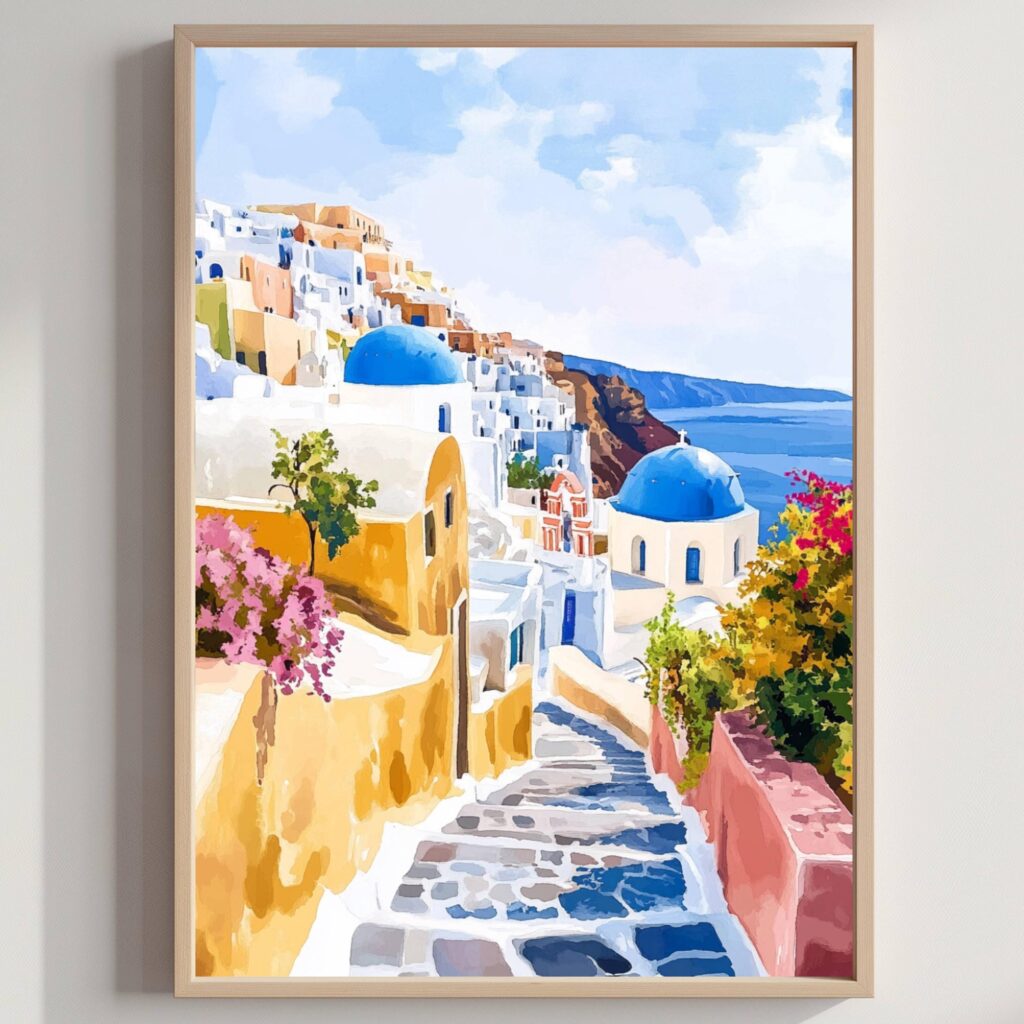
The crescent shape of Santorini isn’t an accident of geography, it’s the rim of a volcanic caldera, the collapsed remains of one of the largest eruptions in recorded human history. Around 1600 BCE, the Minoan eruption blew the island’s centre apart, leaving behind the dramatic cliffs and sunken bay that define Santorini today. What looks like paradise is, geologically speaking, a scar, one that happens to be extraordinarily beautiful.
That eruption is thought by some archaeologists to be linked to the legend of Atlantis, and it certainly ended the Minoan settlement of Akrotiri, buried in volcanic ash and remarkably preserved, a kind of Greek Pompeii, predating its Italian counterpart by over a thousand years. Frescoes, pottery, and multi-storey buildings emerged from the ash largely intact, offering a rare, direct window into Bronze Age life.
White, Blue, and Built Into the Cliff
The villages of Oia and Fira cling to the caldera’s rim, their whitewashed cave houses and blue-domed churches stacked into the volcanic rock in a way that seems almost improbable from a distance. The white paint wasn’t originally aesthetic, it began as a cheap, readily available lime wash, and only later became the deliberate, iconic look the island is now famous for.
Santorini’s sunsets have their own kind of fame: every evening, crowds gather along Oia’s clifftop paths to watch the sun disappear into the Aegean, a ritual so consistent it has become one of travel photography’s most reproduced images. The island’s volcanic soil, meanwhile, produces some of Greece’s most distinctive wines, vines grown low and coiled into basket shapes to protect them from the wind.
Painting the Caldera’s Light
The contrast that makes Santorini so photogenic, blinding white against deep blue, softened by that famous golden evening light, is just as compelling in watercolour. We’ve captured it in our own Santorini Island Watercolor Print, painted first by hand and printed to order on archival paper, a small piece of the Aegean for a wall at home.
Few places carry their geological violence so gracefully. Santorini turned catastrophe into one of the most photographed coastlines on Earth, and it hasn’t stopped drawing people to its rim since.