
Few buildings anywhere carry as much history in as small a footprint as the Tower of London. In over 900 years standing on the north bank of the Thames, it has served as royal palace, armoury, treasury, menagerie, and — most famously — prison and place of execution. To walk its grounds today is to walk through nearly a millennium of English history, layer upon layer, stone upon stone.
William the Conqueror began the White Tower, the fortress’s pale central keep, around 1078 — as much a statement of Norman power over a newly conquered city as a defensive structure. Successive monarchs kept building around it for centuries, adding concentric rings of walls and towers until the compact, formidable complex visitors see today took shape. Few of England’s rulers ever felt entirely safe without it.
Crowns, Ravens, and Infamous Prisoners
The Tower’s most dazzling residents are, quite literally, the Crown Jewels — a working collection of coronation regalia, including the Imperial State Crown, still used in state ceremonies and guarded around the clock. Visitors file past moving walkways to catch a glimpse of St Edward’s Crown and the Cullinan diamonds, among the most valuable objects on public display anywhere in the world.
But the Tower’s darker history is just as much a draw. Anne Boleyn and Catherine Howard were both executed within its walls; the young Princes in the Tower vanished from historical record here in 1483, a mystery still debated by historians today. The Yeoman Warders — “Beefeaters” — who guard the Tower and live within its walls double as its storytellers, leading tours thick with anecdote and dark humour. And then there are the ravens: legend holds that if they ever leave the Tower, the kingdom will fall, so a small resident flock has its wings carefully clipped, just in case.
A Fortress Worth Painting
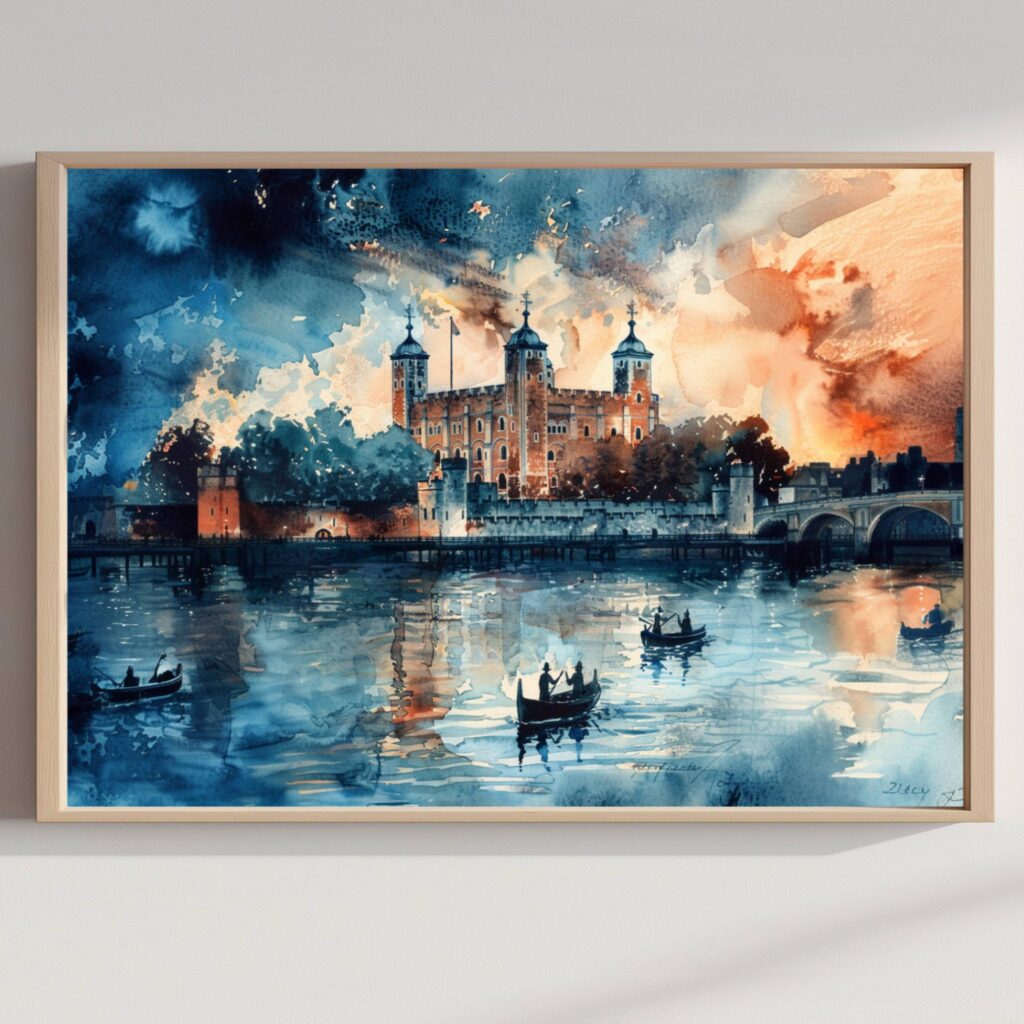
Seen from across the Thames, with Tower Bridge rising beside it and the water catching the light, the Tower of London is one of the city’s most paintable landmarks — pale stone against grey river, centuries of history compressed into a single unmistakable silhouette. We’ve captured that view in our own Tower of London Watercolor Print, painted first by hand and printed to order on archival paper — a small piece of London’s history for a wall at home.
Whether you’ve stood beneath the White Tower yourself or simply grown up on stories of its ravens and its jewels, the Tower of London remains one of the few places where nine centuries of history still feel close enough to touch.